
Digital marketing tactics evolve rapidly, especially with the rising popularity of AI platforms, which makes it crucial for SaaS companies to stay ahead with innovative strategies.
Understanding the latest SaaS industry and marketing statistics can empower your company to enhance its online presence, attract more users, and drive growth in 2026.
From mastering SaaS SEO to leveraging AI and PPC campaigns, these statistics provide valuable insights into effective digital marketing tactics. To help your company stay competitive, we recommend reviewing these key trends.
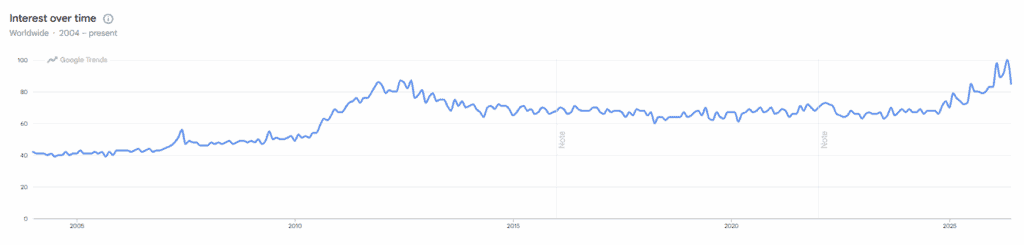
According to Google Trends, SaaS marketing reached unprecedented heights in 2026 as companies increasingly harnessed data-driven strategies and AI technologies for personalized customer engagement. This growth was driven by innovative digital campaigns and a greater emphasis on customer retention, placing SaaS marketing firms at the forefront of the increased demand.
SaaS Growth and GTM
The SaaS market is still growing, but the easy-growth era is clearly over.
Growth is slowing across the SaaS industry. Median growth rates are declining, more companies are seeing flat or negative growth, and existing customers are playing a bigger role in new ARR. For SaaS teams, this means shifting focus from rapid growth to building more efficient, sustainable revenue.
Bootstrapped SaaS companies are holding their own against equity-backed rivals, but rising churn and slower revenue growth show that customers are harder to win and keep. The message is simple: SaaS growth is still possible in 2026, but it requires a smarter GTM strategy (one focused on efficiency, customer value, and clear results).
- Private B2B SaaS companies had a median growth rate of 25% in 2024, down from 30% in 2023.
- 6.9% of private B2B SaaS companies reported flat or negative growth in 2024, up from 5.3% the prior year.
- Bootstrapped SaaS companies had 23% median growth in 2025, while equity-backed companies had 25% median growth in SaaS Capital’s 2025 benchmark.
- Lighter Capital’s 2025 startup benchmark found median annual revenue growth of 28.29%, down from 47.25% the prior year.
- Median revenue churn rose to 12.50% in 2025, up from 11.34% the year before.
- SaaS companies above $50M ARR generated roughly 60% of new ARR from existing customers in 2025.
- Fewer than 25% of SaaS companies monitored KPIs or analytics dashboards to measure the impact of internal AI usage.
SaaS Marketing Budget Statistics
SaaS companies are carefully balancing growth and profitability, leading to more strategic marketing budgets. How much you spend typically depends on your company size, funding model, and go-to-market strategy, with equity-backed teams generally outspending bootstrapped ones.
These SaaS marketing budget statistics also show a growing focus on efficiency.
Bootstrapped companies tend to be more profitable, PLG companies put more budget into programs, and AI is taking up a bigger slice of the pie. For SaaS marketers, it’s not about spending more: it’s about spending smart. Focus your investments on the channels, teams, and tools that will actually move the needle on pipeline and revenue.
- Private B2B SaaS companies spent a median 8% of ARR on marketing in 2026.
- 83% of bootstrapped SaaS companies were breakeven or profitable, compared with 52% of equity-backed companies.
- Equity-backed SaaS companies spent 100% more on marketing than bootstrapped SaaS companies at the median.
- Median B2B SaaS marketing budgets increased from 9% to 10% of revenue in 2025, while 75th-percentile budgets rose from 16% to 20% of revenue.
- Marketing budget as a percentage of revenue declined with scale, from a median 14% below $5M revenue to 4% above $150M revenue.
- PLG companies allocated more of their marketing budgets to programs: 52% to programs and 32% to people.
- 23% of B2B SaaS companies planned to invest 16%–20% of their marketing budget in AI in 2025, up from 11% in 2024.
- 9% of companies planned to spend more than 20% of their marketing budget on AI, up from 4% the year before.
- Private SaaS companies above $100M ARR invested a median 33% of revenue in sales and marketing, matching public SaaS companies.
User Behaviour Trends
B2B software buyers are changing how they research, compare, and choose vendors. AI search, chatbots, review sites, and source-backed research are now shaping the buying journey alongside traditional Google search.
These user behaviour trends show that buyers expect more relevant outreach, stronger AI capabilities, and easier access to trustworthy content. For SaaS teams, the takeaway is clear: show up where buyers are researching, make proof easy to find, and tailor messaging to each segment’s needs.
- 79% of B2B software buyers said AI search changed how they conduct research.
- Roughly 3 in 10 B2B software buyers said they are more productive with AI search than traditional search, and start with AI search more often than Google.
- Among enterprise buyers at companies with 1,000–5,000 employees, review sites were used by 56% and AI search by 55% as top research sources.
- SMB software buyers leaned more heavily on Google, with 47% citing Google as a top research source.
- Generative AI chatbots were the #1 influence on vendor shortlists, cited by 17.1% of B2B software buyers.
- 50% of enterprise buyers switched vendors for better AI capabilities, compared with 42% of mid-market buyers, 41% of large-enterprise buyers, and 32% of SMB buyers.
- 61% of B2B buyers preferred a rep-free buying experience.
- 73% of B2B buyers actively avoided suppliers that sent irrelevant outreach.
- Nearly half of buyers sought review content on vendor websites, according to TrustRadius’ 2025 buyer research.
- 72% of buyers encountered Google AI Overviews, and 7% used LLMs such as ChatGPT as part of the buying process.
- 90% of buyers clicked through to sources in AI Overviews when fact-checking.
PLG and Self-Serve SaaS
Want to grow your business more efficiently? Embracing product-led growth (PLG) and self-serve models is a great place to start. The data shows that teams with self-serve revenue perform better across the board: leading to faster time-to-value, higher conversion rates, and stronger profitability.
These PLG and self-serve SaaS statistics show that removing friction from the buying journey can create meaningful gains. For SaaS marketing teams, the takeaway is to make pricing clear, onboarding fast, and product-qualified leads easier to convert.
- Companies moving from zero to early self-serve revenue saw 25.8% better pricing optimization, 25.9% better free-to-paid performance, and 18.3% faster time-to-value.
- SaaS companies with early self-serve revenue had 68% profitability, versus 36.4% for companies with no self-serve revenue.
- Self-serve companies scored 19% higher on execution-to-growth capability.
- 68.4% of B2B SaaS companies generated under $100K in revenue per employee, while established self-serve companies often exceeded $300K in revenue per employee.
- 40% of B2B SaaS companies rated their time-to-value performance poorly.
- PQL conversion reached 30% for $1K–$5K ACV companies and 39% for $5K–$10K ACV companies.
SEO and AI SEO
SEO is one of the best growth channels for B2B SaaS; it delivers solid ROI, costs less than paid search, and converts well. But the landscape is shifting fast. Zero-click results, AI Overviews, and AI-powered discovery are changing how buyers search for information.
These SEO and AI SEO statistics show that SaaS teams need to optimize for both traditional rankings and AI visibility. The opportunity remains strong, but measurement is lagging, making it important to track organic traffic, AI citations, and source visibility in tandem.
- B2B SEO had an average conversion rate of 5.0% in 2025.
- 27% of marketers who could identify a top channel cited organic search as their #1 channel.
- B2B SaaS SEO showed approximately 702% average ROI with a roughly 7-month break-even period over a three-year window.
- Organic traffic produced a typical SaaS CPL of $147, compared with $280 for paid search.
- 96.98% of clicks happened in the top 10 search results.
- 65.4% of desktop informational queries ended without a click in 2024, up from 58.5% in 2023.
- AI Overviews appeared on 13.14% of Google search queries in January 2025, up from 6.49% in January 2024.
- 67% of B2B marketers in 2025 reported having no formal AEO or GEO measurement system.
- 28% of ChatGPT’s most-cited pages had zero organic visibility in Google search.
Demand Generation and Attribution
Demand generation is under more pressure to prove revenue impact, not just pipeline volume. The data shows that many SaaS teams track opportunities and ARR, but fewer measure efficiency metrics such as CAC ratio, cost per opportunity, or pipeline conversion.
SaaS marketers need tighter alignment between brand, demand, and revenue reporting. As inbound performance varies by ACV, teams should focus on the channels and metrics that best connect marketing activity to real bookings.
- 28% of marketers projected revenue growth of 11%–20% in 2025.
- Only 29% of companies had fully integrated brand and demand marketing.
- 51% of companies tracked opportunities generated, and 36% tracked new ARR bookings as core marketing metrics
- Efficiency metrics were less common: 18% tracked cost per opportunity, 15% tracked marketing CAC ratio, and 16% tracked pipeline conversion.
- 52% of companies measured marketing cost per dollar of pipeline, while 46% measured marketing cost per dollar of new-logo ARR.
- Inbound leads were less correlated with growth than expected, but faster-growing companies still tended to have a higher percentage of new bookings from inbound.
- As ACV rose above $50K, companies relied less on inbound leads.
ABM and Personalization
Account-Based Marketing (ABM) is now a key strategy for SaaS growth. As buying decisions involve larger groups, reaching decision-makers gets harder. Most marketers already use ABM to solve this, combining personalized outreach and coordinated campaigns to deliver the best results.
The data is clear: focus drives results. Prioritizing the right buying groups, aligning ABM with demand generation, and using AI thoughtfully for personalization all lead to stronger outcomes.
- Nearly 80% of marketers are actively executing ABM.
- Marketers rated AI effectiveness for improving ABM outcomes at an average 7.3 out of 10.
- Personalized content was the highest-ROI ABM tactic, cited by 47% of respondents.
- 40% of ABM practitioners integrate ABM with demand generation.
- 45% of ABM practitioners saw promise for AI in personalization, while nearly 70% said current AI effectiveness was limited.
- B2B buying groups typically include 13–17 stakeholders.
- Win rates peaked around 29% when teams focused on three buying groups, but fell to roughly 12% when teams pursued six.
- Buying groups receiving 180–190 coordinated touches approached 94% conversion.
Trust Spacebar with Your SaaS Marketing Needs
SaaS growth is becoming more complex, but the opportunity remains for companies that know where to focus.
From demand generation to SEO and AI search, the data points to one clear takeaway: efficient growth now depends on sharper strategy, better execution, and a deeper understanding of how buyers make decisions.
Need help turning these insights into pipeline and revenue?
Contact Spacebar Collective today to build a smarter SaaS growth strategy for your business.