


B2B inbound marketing attracts informed, qualified leads who are ready to buy. We discuss why SEO leads this channel and other proven strategies to make it work for your brand.
If you’ve been in the B2B space for any length of time, you’ve probably noticed something about buyers today. They don’t answer cold calls like they used to. They rarely reply to mass prospecting emails. Before they ever talk to a sales rep, most have already consumed case studies, scanned comparison articles, and asked questions in communities.
Gartner’s B2B Buying Journey Report found that 75% of today’s B2B buyers prefer a purchase experience with zero sales rep interaction. This trend tells us, in no uncertain terms, that inbound marketing is far more important than it’s ever been.
Leads that find you through research arrive interested and are more likely to convert than anyone you try to chase down. With that in mind, inbound marketing works to make you the answer your buyers find during their research.
This article briefly explains what B2B inbound marketing looks like today, why SEO sits at the center of it, and proven strategies you can immediately apply to position your brand where your buyers are already searching.
B2B Inbound Marketing in the Buyer-Led Era

Source: Nicolas J Leclercq @ Unsplash
For a long time, the B2B sales playbook was built on a simple premise: go find your customers. That meant cold calls, paid ads, and similar tactics that put your message directly in front of an audience, whether they wanted it or not. This is outbound marketing.
Inbound marketing, by contrast, is a complete shift in philosophy. It’s the practice of becoming the answer your buyers find during their research. Put simply, it’s about earning attention rather than actively pursuing it.
Coined by HubSpot in the early 2000s, B2B inbound marketing gained prominence because the modern buying journey has fundamentally changed. Buyers lead the process now. They find helpful resources, skim third-party reviews, and consider speaking with a vendor only when they’re close to a decision.
A World Business Research study found that most buyers are about 57%-70% through their research by the time they contact sales. Inbound works because it aligns with this reality. Rather than try to wrestle attention away, it rewards companies that are easy to find, easy to trust, and easy to learn from.
For B2B brands especially, inbound has become less optional and more of the default way buyers discover who they’ll do business with. And on that note, let’s go over several proven B2B inbound marketing strategies you can implement right away.
SEO: The Engine Behind Successful B2B Inbound Marketing
While inbound marketing includes many moving parts (from social media to email campaigns), it’s often driven by a single, powerful engine: search engine optimization (SEO).
For most B2B brands today, SEO is the primary discovery channel for the high-quality, research-first leads you want to attract. Across many case studies, brands that optimize their website and content for search engines see significantly more ROI than those that don’t.
The data backs this up, too. On average, buyers visit a supplier’s website more than any other touchpoint during their research. It is, after all, where they expect to find the clarity and substance that helps them move forward.
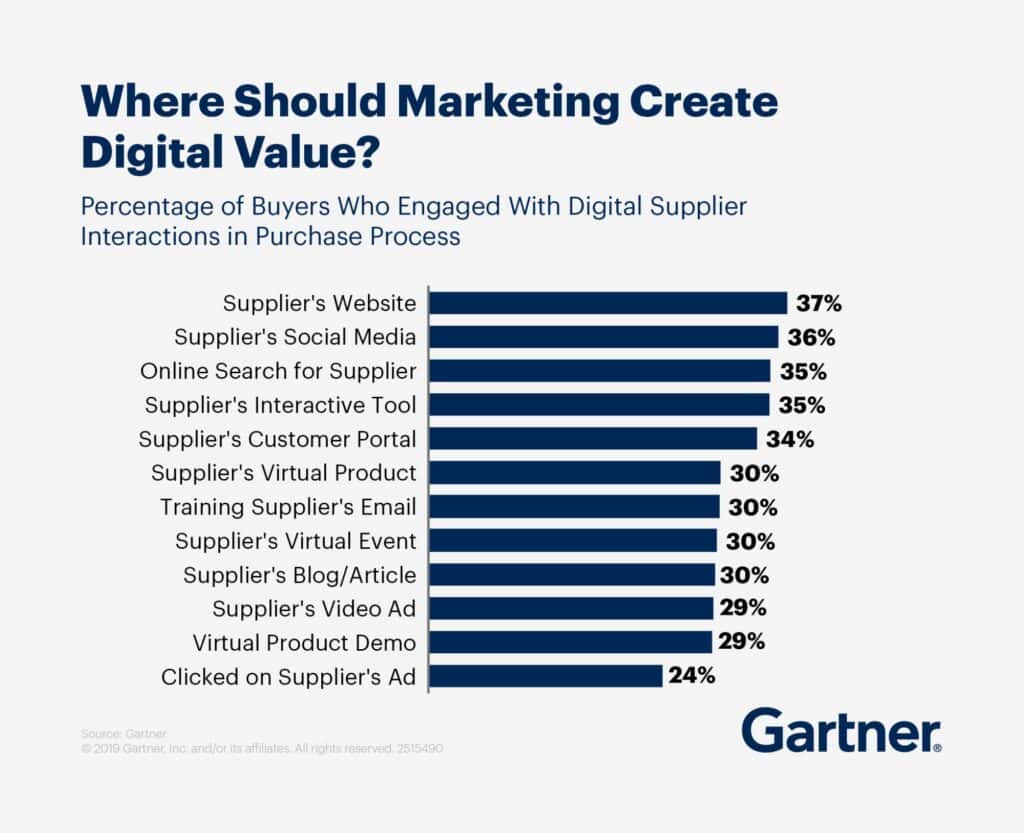
Source: Gartner
It’s worth noting that B2B SEO differs significantly from consumer SEO. Queries are often more complex, sales cycles are longer, and multiple decision-makers are involved. Your SEO strategy must account for this.
Let’s briefly see how core SEO principles power the gears of your inbound machine:
Keyword Strategy
Your keyword strategy is your roadmap. Instead of targeting generic, high-volume terms, you’ll focus on the precise questions your ideal buyers are asking. This includes problem-aware searches (e.g., “how to reduce SaaS churn”) and solution-aware searches (e.g., “best CRM for small business”).
A mature strategy also understands that keyword optimization and SEO itself are evolving. Thanks to generative AI platforms like ChatGPT and Gemini, the focus is now on optimizing for meaning and relevance, not just terms. LLM SEO overlaps with traditional SEO but also has its own nuances.
Today, it’s all about making your content the most reliable signal in a sea of noise through entity optimization. This means building a web of interconnected, LLM-friendly content that shows your authority on an entire topic, rather than a single keyword.
Content Creation
Content is the fuel. Your goal is to build topical authority by creating comprehensive, helpful content that answers every possible question a B2B buyer might have.
For instance, a cybersecurity SaaS company shouldn’t stop at writing a single blog post on “data breaches.” It instead needs to create a full content hub that covers everything from “what counts as a data breach?” to “how to prevent a breach with a secure access protocol.”
This deep, interconnected content tells search engines that your brand is the definitive source of truth on a given subject.
Technical Foundation
A technically sound website is non-negotiable. A fast-loading site with a clear, logical structure ensures both search engines and human users can navigate and find your valuable content.
This is where elements like mobile optimization and schema markup (structured data) become vital. For a B2B SaaS, schema markup can help search engines understand what a specific page is about (e.g., a product page, a how-to guide, a case study), which in turn helps them present your content to the right user at the right time.
Link Building
Backlinks are the trust signals. By earning backlinks from reputable industry publications and authoritative sources, you’re building your brand’s reputation alongside improving your rankings.
A mention in a trusted tech news outlet (like TechCrunch) or a link from a respected partner’s blog acts as a stellar vote of confidence to human users, search engine algorithms, and now, generative AI platforms like ChatGPT.
This integrated approach to SEO creates a compounding engine of visibility that attracts qualified leads at scale. In fact, it’s been well established that a single, well-researched article on a high-intent topic can generate inbound leads for years to come.
Content Marketing That Converts Prospects into Buyers
Content is where most inbound journeys begin. In B2B, buyers want proof, clarity, and direction at each stage of their research.
Early on, thought-leadership pieces and industry reports help frame the problem. Mid-funnel, comparison guides, and solution explainers narrow down the field. At the decision stage, case studies and customer stories show what’s possible in practice.
In a survey conducted by Future B2B, most content marketers found virtual events, webinars, research reports, and articles/blog posts (under 3,000 words) to be the most effective content assets they’ve most recently used:
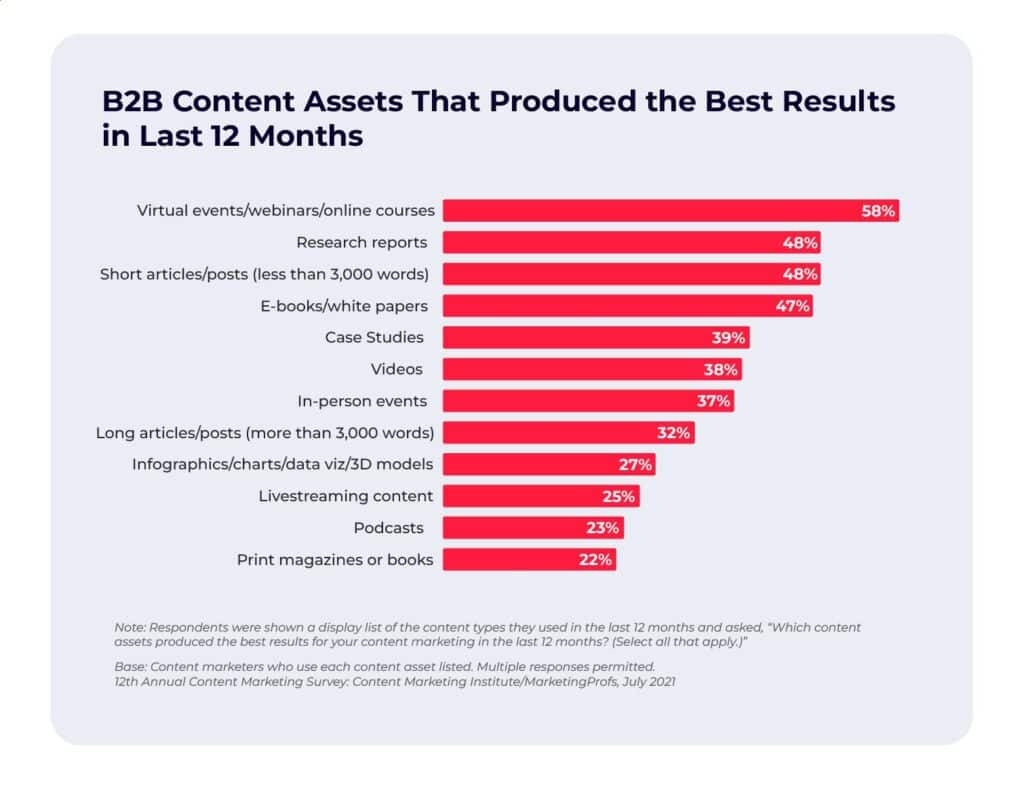
Source: Future B2B
Keep in mind that effective content marketing doesn’t stop at publishing new content. It gets distributed through owned channels, social platforms, SMS campaigns, and email nurturing outreach that keep your brand top of mind.
To capture contact information naturally, you need to create compelling lead magnets. These are high-value pieces of content, like industry reports or interactive tools, that a prospect can download in exchange for their contact info.
This approach provides real value to the user while turning an anonymous visitor into a warm lead. Measuring performance then means tracking engagement metrics that predict conversion, like time on page for a case study or download rates for your lead magnets.
Email and Social Media: Amplifying Your Inbound Strategy
Once you’ve used content and SEO to attract a prospect, your email and social media channels become the amplifiers that keep them engaged and move them closer to conversion.
Email marketing helps build a direct, one-on-one relationship with your leads. A well-designed email nurturing sequence can automatically send relevant case studies, webinar invitations, or product updates to leads, delivering the right information at the right time.
For example, a prospect who downloaded an “industry trends” report could receive a follow-up email with an exclusive article on how a specific product feature addresses those trends.
On the other hand, social media (particularly LinkedIn, which accounts for 80% of B2B social media leads) is the public extension of your brand’s authority. It’s where you engage with industry discussions and show your team’s thought leadership.
It’s also a critical source for social proof. When you share customer testimonials or showcase positive client reviews, you’re building trust in a public forum.
Why Third-Party Validation Fuels B2B Inbound Marketing
Inbound isn’t just what you publish; it’s also what others say about you. Third-party mentions in industry outlets and respected directories act as credibility signals that buyers notice. Guest posts, media features, and even a well-maintained Wikipedia page make your brand feel established.
Authority feeds directly back into SEO, strengthening your rankings and visibility. But more importantly, it makes your buyers trust you faster. When a lead sees your brand discussed beyond your own site, it reinforces the message that you’re not only prominent in the market, but also helping shape it.
Spacebar Collective: Your Partner for Sustainable B2B Inbound Growth

At Spacebar Collective, inbound is the work we do every day with B2B SaaS companies navigating the same buyer behavior shifts you’ve just read about. We help brands structure SEO strategies that turn organic search into predictable lead generation.
We specifically focus on:
- High-quality content production at scale and authoritative backlink building
- Brand clarity and authority signals that Google and your buyers recognize
- Optimizing for the way brands are now being surfaced in generative AI search
In practice, this includes everything from creating content roadmaps to capture traffic to ensuring your technical SEO foundations are solid. We also fold in PR-driven visibility and thoughtful reputation-building so your brand isn’t just found, but trusted.
If you’re ready to see how visible your brand is in the places your buyers are searching, we offer a free, comprehensive SEO audit with actionable insights you can immediately apply.
Final Thoughts
B2B inbound marketing works because it reflects how buyers make decisions today. Instead of chasing attention, you build a credible presence where it’s already being sought.
SEO sits at the center of this model because it drives visibility at scale and compounds over time. Content, email, social, and PR add layers of trust and authority, turning discovery into preference and preference into pipeline.
Inbound’s long-term strength is its compounding effect. Every optimized article, every earned backlink, every authoritative mention builds toward a brand presence that feeds itself over time.
At Spacebar Collective, we develop and manage SEO strategies tailored to B2B SaaS companies. Our managed SEO services are built to earn inbound leads that convert. If you’d like to see how this can work for your business, contact us today to get started.