


Raising venture capital isn’t the only way startups can secure funding for growth. Venture debt offers high-growth companies an opportunity to access additional capital without giving up a significant portion of their ownership.
For venture-backed startups, taking on debt can extend their cash runway between funding rounds, providing more time to reach revenue targets and other important milestones.
But unlike traditional business loans, venture debt is designed for companies that may not yet be profitable. Understanding how venture debt works, what it costs, and its potential risks is essential before deciding whether it’s the right financing strategy.
What Is Venture Debt?
Venture debt is a specialized form of business financing designed primarily for startups that have already raised capital from venture capital investors. It allows companies to borrow money without issuing additional shares, helping founders preserve equity while funding continued growth.
Unlike traditional bank loans, venture debt doesn’t necessarily require a company to be profitable or to have a lengthy credit history, making it a useful option across different startup funding stages. Instead, lenders look at factors such as revenue growth, existing investors, cash reserves, and the likelihood of securing future funding.
Venture debt typically complements equity financing rather than replacing it. Startups often use both funding methods to support expansion while minimizing ownership dilution.
The key distinction is that equity financing involves selling ownership in the business, while venture debt must be repaid with interest.
Some venture debt agreements also include warrants, which give lenders the right to purchase equity in the company.
How Does Venture Debt Work?
Venture debt allows startups to borrow additional capital after raising equity financing, typically without giving up a significant ownership stake.
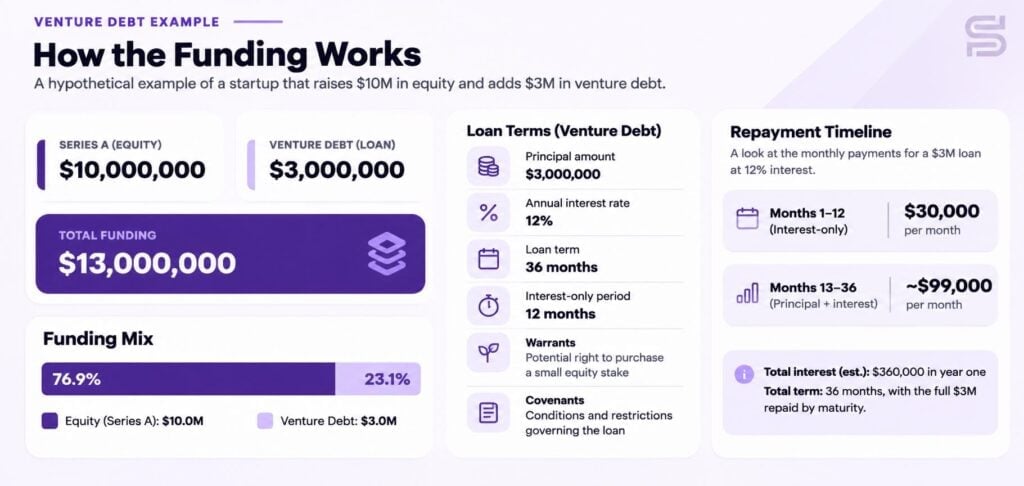
For example, imagine a B2B SaaS that raises $10 million in Series A funding.
Rather than raising another equity round to finance its expansion, the company secures an additional $3 million in venture debt. This gives the startup $13 million in total funding while limiting further equity dilution.
Here’s how the process works.
1. The Startup Raises Venture Capital
Most venture debt financing begins after a startup has successfully raised money from venture capital investors.
A company that recently secured $10 million in Series A funding may qualify for an additional $3 million loan based on its growth prospects, financial position, and investor backing.
Lenders view established venture capital investors as a positive signal because their involvement can increase the likelihood of future funding rounds.
2. The Lender Sets the Loan Terms
Once a lender approves financing, both parties negotiate the loan structure, repayment schedule, and associated costs.
For our hypothetical $3 million venture debt agreement, the terms might include:
- Principal Amount: $3 million
- Annual Interest Rate: 12%
- Loan Term: 36 months
- Interest-Only Period: 12 months
- Warrants: The lender may receive the right to purchase a small equity stake.
- Covenants: Financial requirements and contractual restrictions that the startup must follow.
These figures are illustrative. Actual venture debt terms depend on the lender, the startup’s financial position, market conditions, and perceived lending risk.
3. The Startup Makes Interest and Principal Payments
Venture debt agreements often include an interest-only period, allowing startups to make smaller payments during the early stages of the loan.
For example, a $3 million loan with a 12% annual interest rate would initially require $30,000 in monthly interest payments.
If the loan includes a 12-month interest-only period, the startup would pay $360,000 in interest during its first year without reducing the principal balance.
After this period, the company begins repaying both principal and interest according to the agreed amortization schedule. The outstanding loan balance must be repaid by the maturity date, unless the debt is refinanced or otherwise restructured.
4. The Company Uses the Capital to Grow
Startups typically use venture debt to finance growth initiatives that would otherwise require additional equity funding.
Common uses include hiring employees, developing new products, acquiring customers, and expanding into new markets.
For example, a SaaS startup might invest its $3 million loan in sales and marketing to accelerate customer acquisition before its next funding round.
Additional financing can extend a company’s cash runway, giving it more time to achieve revenue milestones and potentially secure a higher valuation.
However, venture debt also introduces ongoing repayment obligations. Startups must account for interest and principal payments when forecasting cash flow, as these expenses can shorten their runway if growth doesn’t materialize as expected.
How Much Does Venture Debt Cost?
Venture debt costs vary depending on the lender, loan structure, and startup’s financial position. Beyond interest payments, founders should account for additional fees and potential equity dilution.
Interest Rates and Financing Fees
Venture debt can carry fixed or variable interest rates. Fixed rates remain consistent throughout the loan term, while variable rates fluctuate with a benchmark rate.
Lenders may also charge origination fees, closing costs, and end-of-term payments. These additional expenses mean the advertised interest rate doesn’t always reflect the total cost of borrowing.
Warrants and Equity Dilution
Some venture debt agreements include warrants, which give lenders the right to purchase company shares at a predetermined price.
Lenders use warrants to participate in a startup’s potential growth alongside collecting interest payments.
Although venture debt generally causes less dilution than equity financing, exercising these warrants can still reduce existing shareholders’ ownership percentages.
Venture Debt vs. Equity Financing
The biggest difference between venture debt and equity financing is how they affect ownership and repayment obligations.
Imagine a startup valued at $20 million before new financing, with its founder owning 40% of the company.
If the startup raises $3 million in equity, the founder’s ownership decreases to approximately 34.8%, assuming they don’t participate in the funding round.
Borrowing $3 million through venture debt instead preserves their 40% ownership stake, excluding potential warrant dilution.
Here’s how the two financing methods compare:
Startup Funding Comparison
Venture Debt vs. Equity Financing
| Feature | Venture Debt | Equity Financing |
|---|---|---|
| Ownership dilution | Limited or none | Yes |
| Repayment required | Yes | No |
| Interest payments | Yes | No |
| Financial risk | Debt obligations | Ownership dilution |
| Lender/investor upside | Interest and potential warrants | Equity appreciation |
Venture debt may still involve equity dilution through warrants.
While venture debt preserves ownership, the additional repayment obligations can outweigh its benefits if a startup struggles to generate revenue or raise additional funding.
Why Do Startups Use Venture Debt?
Startups use venture debt to access growth capital while maintaining greater control over their ownership.
There are three primary reasons companies pursue venture debt:
Extending Cash Runway
Venture debt provides additional cash between funding rounds, giving startups more time to reach revenue targets, product milestones, or profitability before raising more capital.
Financing Growth Initiatives
Companies can use venture debt to hire employees, accelerate customer acquisition, or expand operations. Ideally, these investments generate measurable returns that justify the borrowing costs.
Reducing Founder Dilution
Borrowing allows founders to avoid selling additional shares at an unfavorable valuation. Reaching growth milestones before the next funding round may also help startups negotiate better terms with investors.
What Are the Risks of Venture Debt?
While venture debt limits equity dilution, startups should consider several financial risks:
- Repayment Pressure: Interest and principal payments reduce cash reserves regardless of profitability.
- Fundraising Uncertainty: Future investment rounds aren’t guaranteed, which could jeopardize repayment.
- Restrictive Covenants: Lenders may impose financial requirements or borrowing restrictions.
- Collateral and Default: Lenders may seize pledged assets following a default.
- Additional Costs: Warrants, fees, and penalties increase borrowing expenses.
These risks can worsen financial difficulties if growth falls below expectations.
Who Qualifies for Venture Debt?
Venture debt lenders typically prioritize startups with strong growth prospects and established financial backing.
Common qualification requirements include:
- Investor Backing: Previous funding from reputable venture capital firms.
- Financial Stability: Sufficient cash runway and consistent growth.
- Revenue Performance: Recurring revenue or predictable business performance.
- Repayment Strategy: A clear plan for future fundraising or loan repayment.
Bootstrapped businesses may find conventional loans, business lines of credit, or cash-flow-based financing more accessible.
Is Venture Debt Right for Your Startup?
Venture debt can help startups finance growth without substantial equity dilution. However, it works best with predictable cash flow and a realistic repayment strategy.
Founders should weigh the total borrowing costs against the benefits of preserving ownership.