
When you expand your business to multiple locations, your local SEO strategy needs to adapt. Optimizing for local search is key to being seen by customers in each market, rather than putting all your eggs in one basket.
This guide explains effective strategies to improve local rankings in Google Search and Google Maps, prevent duplicate content issues, as well as attracting new customers for your business.
Why SEO for Multiple Locations Needs a Different Approach
When marketing multiple locations with SEO, a unique strategy is needed for each one. This is because every location has its own set of keywords, competitors, and customer demographics.
Business owners may find it overwhelming to balance efforts between locations, so working with an experienced agency like Spacebar Collective is a great way to save yourself time, stress, and resources.
Duplicate Content Issues
Duplicate content refers to any text that appears in more than one place online. This can confuse search engines and hurt your search rankings, as sharing the same content across multiple pages dilutes its value.
To avoid duplicate content issues, it’s important to create unique and high-quality content for each location. For each one, you can create a dedicated landing page with helpful details such as services, contact information, and region-specific customer reviews.
NAP Consistency
NAP stands for Name, Address, and Phone number. Consistent NAP information across all your online business listings is crucial for local SEO. It helps search engines validate your location and contact details, which can improve your search visibility and build trust with customers.
If your business information is inconsistent across online directories, search engines may struggle to verify your legitimacy. This can lead to lower search rankings and negatively impact your presence in Google Maps results.
Creating Location-Specific Content
Businesses should publish location-specific landing pages that highlight their services and offerings, as well as educational blog content that addresses local interests and challenges to engage their audience effectively.
For example, we have a Calgary SEO page because that’s where our head office is located, along with supporting blog content that focuses on SEO companies in Canada.
Earning Location-Specific Reviews
Online reviews play a crucial role in your local SEO performance.
Having a system to gather, manage, and respond to reviews is essential. Reviews signal credibility to search engines, which can improve your rankings. Positive reviews also improve conversion rates, as most customers do their due diligence before making a purchase.
Location-specific reviews can be challenging for small to medium-sized businesses due to limited customer interaction and fewer resources to manage and respond to feedback. Prioritizing these reviews is crucial. They enhance your local SEO, boost your credibility, and attract more local customers.
Balancing Local and National SEO Goals
Balancing local and national SEO goals is difficult because each requires distinct strategies; local SEO focuses on optimizing for specific geographic areas, while national SEO targets a broader general audience.
An effective multi-location SEO campaign strategy combines local and national tactics. This ensures each location ranks well in its specific area while maintaining a strong, unified brand presence across all markets.
Managing Multiple Google Business Profiles
Managing multiple Google Business Profiles can be challenging, but is essential for local SEO performance and lead generation across all locations. By optimizing each profile effectively, businesses can improve their visibility in Google Maps, driving more traffic and conversions.
Optimizing Your GBP Listings
One of the biggest mistakes a business can make with its GBP is failing to fill out every field of its listing thoroughly and accurately. If you aren’t sure if you’ve fully filled out your GBP, it’s likely that there’s work to be done.
Log in to Google Business, or alternatively, just search your business name, and you should see a menu like the one in the screenshot below.
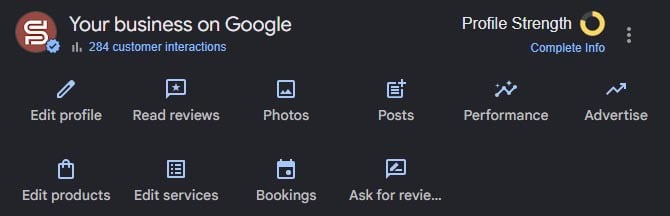
Click on “Edit profile” and ensure each field is filled in accurately. To be sure you’re getting everything done, here’s a handy checklist you can use as you go along:
Next, you’ll want to make sure your products and services are up to date and consistent with what’s on your website. This consistency signals to Google that your GBP is accurate and trustworthy.
Repeat this process for each of your locations, and be sure to monitor your Google Business Profile regularly for any necessary updates. This will not only improve your visibility on Google Maps but also create a better experience for potential customers.
Remember, your GBP is often the first point of contact with potential customers and can greatly impact their decision to do business with you. Take the time to make it a valuable resource (just like your website) and showcase all that your business has to offer.
Making Posts on Your GBPs
Google Business Profile posts can help improve your local SEO. By regularly sharing updates, you increase your visibility in local search results and engage potential customers in your area.
Many businesses overlook the power of regularly updating their Google Business Profiles, allowing those who post even once a week to significantly enhance their visibility in local search results. This simple yet effective strategy can set your business apart from competitors who neglect this crucial aspect of local SEO.
Here are some GBP post ideas you can use for your multi-location business:
- Highlight Products or Services: Highlighting products and services in your Google Business Profile posts, whether it’s a new offering or a well-established favorite, can capture customer interest and drive engagement.
- Promote Special Deals and Offers: Share any promotions, discounts, or limited-time offers on your GBP. This can attract local customers looking for a good deal and increase foot traffic to your business.
- Share Company News and Blogs: Keep your audience updated on any exciting news about your business, such as new locations opening up or awards received.
Location and Service Area Website Pages
You’ve likely already built landing pages for your products and services, so why not create landing pages that are region-specific and highlight your offering?
Location pages on your website help customers in specific areas find your business by improving your visibility in local search results. They also allow you to create content tailored to each community’s specific needs, which can, in turn, drive new business.
Elements of a High-Converting Location Page
Optimized location pages should make it immediately clear that you serve that location, understand that location’s unique needs, and have successfully helped customers there before. That’s what drives both rankings and conversions.
If you need help with web development, get in touch with us today, and we can help you design and deploy your new location pages!
- Clear Location-Specific Headline: Immediately lets readers know they’re in the right place by including the city or region name in the heading.
- Strong Value Proposition Above the Fold: Readers should know what you offer, where, and why they should trust you without scrolling down the page.
- Prominent Call-to-Action (CTA): Make it obvious for readers what their next steps are to engage with your business. The most common CTA is to contact you immediately!
- Unique Location-Specific Content: Avoid reusing the same or similar content across your locations. Identify location-specific needs and highlight how you address those challenges.
- Social Proof: Demonstrate your business’s trustworthiness through reviews, case studies, testimonials, and star ratings.
- Local Photos: Avoid stock photography whenever possible; opt for photos of your team, locations, and projects instead.
- Trust Signals: Do you have any certifications, awards, or memberships in associations? Highlight them on your location pages!
- Frequently Asked Questions (FAQs): Answering common location-specific questions helps improve visibility when people search for answers on Google.
Backlink Building for Multi-Location SEO
Building backlinks to your location pages improves local rankings by signaling to search engines that your business is relevant and authoritative within specific geographic areas.
Backlinks not only improve the credibility of your location pages but also drive targeted traffic from users who are specifically searching for services in those regions.
Think of backlinks as votes of confidence. When another website links to yours, they’re essentially vouching for you and telling their audience (and Google) that your site is credible.
While there are many different ways you can be creative to earn backlinks, these are the most consistent backlink building techniques you can leverage for your multi-location business:
Citation Building
Citation building involves listing your business’s information, such as name, address, and phone number (NAP), on various online directories and platforms. This not only enhances local SEO by reinforcing your business’s presence across the web but also increases the likelihood that people discover your services when searching in specific regions.
The simplest way to build citations is to use a service like BrightLocal to submit your business to all relevant directories and map platforms, such as Apple Maps. While you can do these directory submissions yourself for free, the cost of using BrightLocal is relatively low, and they do a great job of filling out your listings with accuracy and consistency.
Strategic Partnerships
Partnerships are an extremely effective way to build region-specific backlinks, which can rapidly improve your local rankings. Partnering with complementary businesses, organizations, and event planners is a great way to not only build links but also make an impact on your community.
Here are some of the most common partnerships you can make locally:
- Charitable Organizations: Partnerships with local charities can earn you homepage or logo backlinks. These partnerships can take various forms, from sponsorships to providing volunteer work.
- Local Business Associations: Joining your local chamber of commerce is a great way to get your brand featured to fellow business owners in your region. You can also consider town councils and mastermind groups.
- Educational Institutions: Partner with local post-secondary institutions by offering guest speaking or practical training workshops. These partnerships are especially effective because they often include a mention on their blog, newsletter, and event pages.
- Event Sponsorships: Local festivals, community gatherings, and industry events are often cost-effective ways to promote your business locally and earn a valuable backlink from the partnership.
Guest Blogging
Guest blogging is one of the most powerful and consistent backlink building tactics.
Unlike other link building tactics, guest posting gives you full control over the anchor text, target URL, and surrounding copy. Google takes all of these into consideration when weighting the value of a backlink, meaning you can build highly relevant backlinks that align with your specific SEO goals.
Securing guest post placements on websites can be as simple as contacting website admins, pitching your blog topic ideas, or as complex as running large-scale operations using lead databases like Apollo and Hunter.
If you’ve never done cold email outreach before, we advise talking to an expert who can either handle it safely for you or help set up your infrastructure.
Building Internal Links to Your Location Pages
Internal links in SEO are hyperlinks that connect one page of a website to another page within the same domain, helping users navigate the site.
They are an essential part of on-page SEO because they distribute page authority and ranking power across the website, improving indexing and boosting overall visibility in search results.
The most common ways to build internal links to location pages are:
- Navigation Links: Add a section to your website header and footer with links to each of your location pages.
- Service Page Links: Link from a service page (e.g., “Roof Repair”) to relevant city pages (e.g., “Roof Repair in Calgary,” “Roof Repair in Airdrie”).
- Contextual Links from Blogs: Adding internal links from your region-specific blog content to your location pages signals to Google that your business should be recommended in that area.
- Project and Case Study Pages: Link to your location pages from case studies specific to that region.
How to Track Local Search Performance
Unlike national or global SEO campaigns, where you track the performance of an individual keyword, tracking local search performance requires specialized tools.
Using BrightLocal for Google Maps Rankings
BrightLocal’s Local Search Grid is a visual tool that displays your business’s search rankings across different locations in a specific area. It allows you to see how your business performs in local search results and helps you identify where you can improve your ranking.
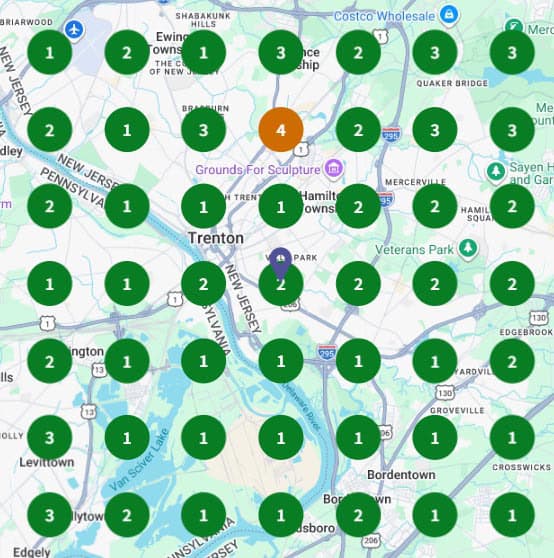
Using Local Proxies for Regional Search Results
Another way to track local search performance is to use local proxy services to simulate searches from different locations. This allows you to see how your business appears in regional search results and make adjustments accordingly.
While you could just Google a keyword while you’re physically at one of your locations, being able to check how search results look from multiple locations without traveling is a huge advantage over your competitors, who are less tech-savvy.
Why You Should Use Spacebar for Multi-Location SEO
Here at Spacebar Collective, we have a proven track record in SEO for multiple locations, helping businesses rank locally across all their Google Business Profiles.
We understand the importance of accurately representing your business in search results, and our team of experts can help you achieve this.
Contact us today for a free consultation call to discuss your business’ needs, your SEO goals, and how we can help you drive results.