


Launching a startup is exciting, especially if you’re bootstrapped and doing things in-house. You control every aspect of your brand, products, and services. However, many startups with amazing products don’t get the traction they deserve because their GTM strategy lacks velocity.
According to Oberlo data, the number of startups has doubled since the last decade and is expected to increase in the next few years. Look at the spending in SaaS. Data from SaaS Capital suggests marketing is the third-highest budget spend for startups.
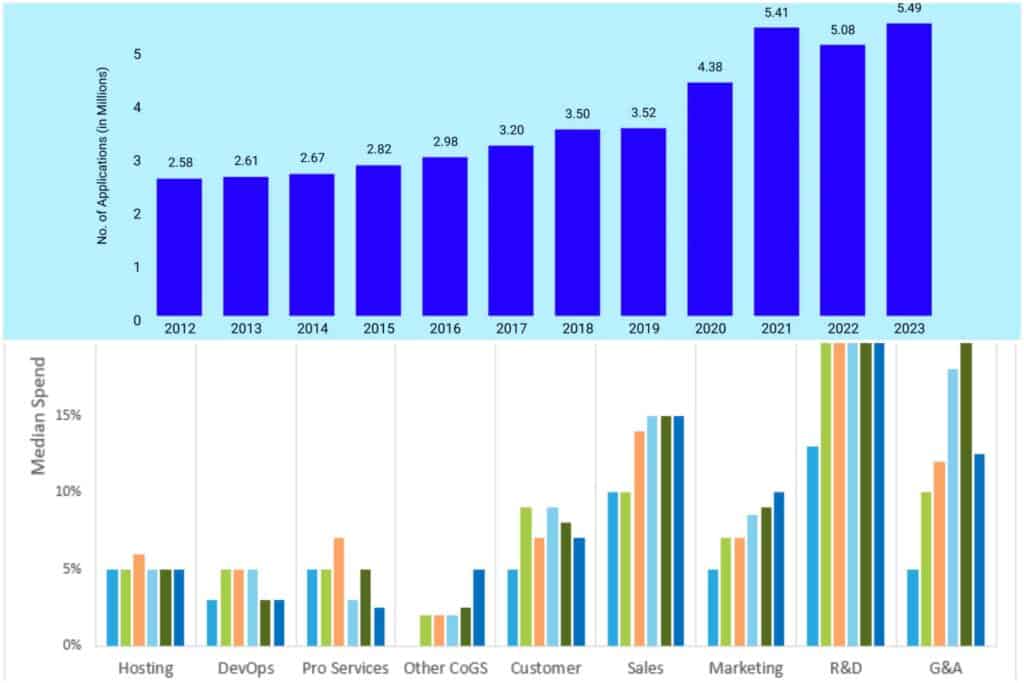
That means competition is fierce, and SEO is one of the most, if not the most, competitive marketing branches. Spacebar Collective has been helping grow and scale startups through SEO for years, and we’re here today to give fundamental and actionable tips to get you rolling.
SEO Checklist for Startups: The Non-Negotiables
These are the essential building blocks every startup should cover before chasing advanced strategies. If you’ve done little to no optimizations on your website and Google Business Page (GBP), completing the following SEO fundamentals can bring significant results:
Website Content Structure: Context and Consistency are Everything
Your website should be the single strongest source of truth. That means consistent messaging on your homepage, service or product pages, and commercial content. Headers should be structured to mirror your customer journey:
- Clear H1 that states your value
- H2s that break down features, use cases, or benefits
- H3s that support details or FAQs
For example, Instantly.ai, has this on-page SEO structure for their homepage. Their H1 is “Find, Contact & Close Your Ideal Clients.”
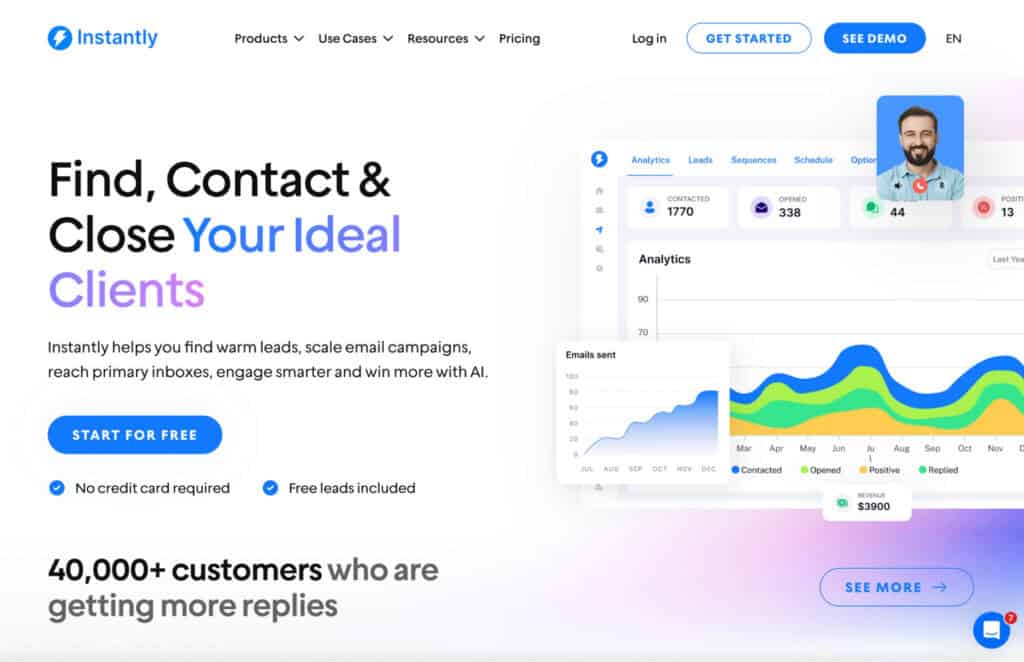
The H2 headers are the features that help their users “Find, Contact & Close Your Ideal Clients.”
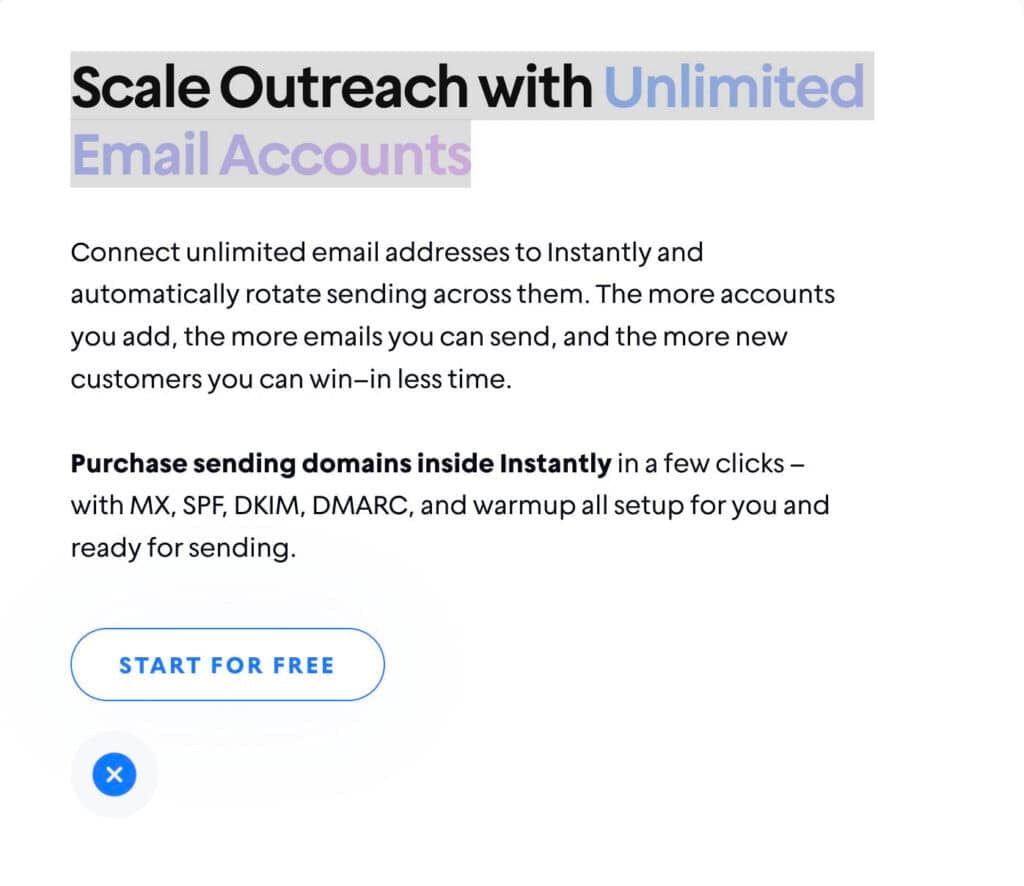
Every feature under an H2 header can be expanded with H3 headers highlighting specifics. Instantly has a feature called Unibox. To provide context for what it does, we have this H2 header: “Respond to Leads and Close Deals with Unibox.”

The H3 headers expand on Instantly’s Unibox feature by adding supporting details. The pattern is straightforward: H1 introduces the core entity, each H2 highlights a feature with context, and H3s provide specific explanations beneath those features.
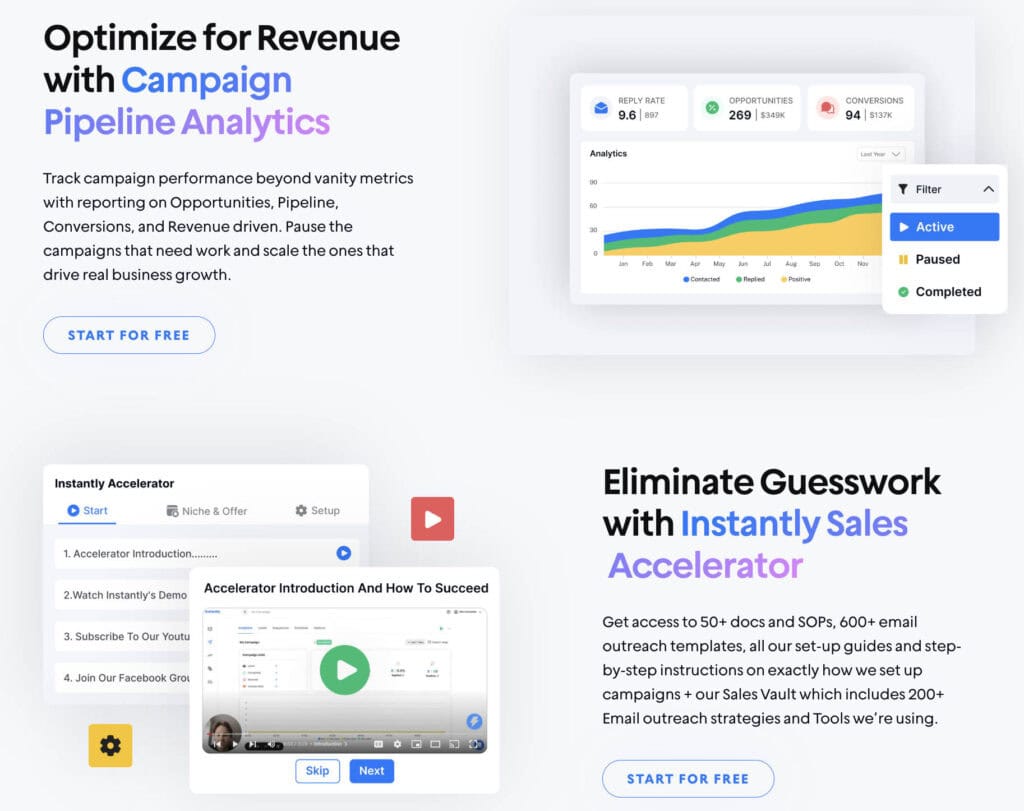
When that structure is reinforced across your blog posts, press mentions, ad copy, and social bios, Google begins to see a consistent entity. The more consistent the signals, the more authority you build, helping your rankings and visibility scale alongside your growth.
Set Goals and Metric Tracking
SEO is synonymous with keyword research, rankings, and traffic. Most would immediately look for tools that help track these metrics. However, you don’t have to invest in expensive SEO tools early on. What’s important is setting up Google Analytics 4, Search Console, and Tag Manager.
GA4 provides a detailed breakdown of every interaction on your website, where traffic comes from, and overall user behavior. But to get specific with the data, you must install Tag Manager.
Tag Manager tracks actions like demo requests, form submissions, video views, or clicks on your pricing page. Meanwhile, Google Search Console will be your best friend if you want a high-level overview, automated insights, and actionable search data.
Build a Content Roadmap
Google values high-quality, helpful, and fresh content. That’s why content velocity is such a crucial factor when doing SEO for startups. If you think about it, competitors won’t sit around and do nothing. They’ll also be constantly updating their content.
To stay relevant, you must follow a content roadmap centered around providing topical authority. The best way to do that is by leveraging keyword research tools like Semrush or Ahrefs. There are also more affordable tools, like Mangools, that focus mainly on keywords alone.
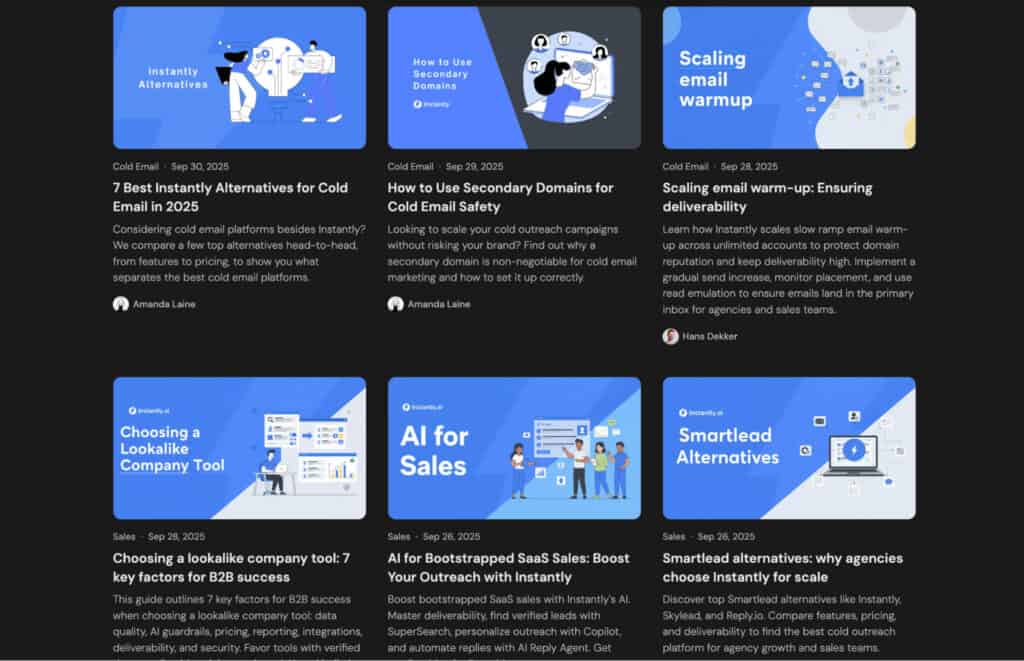
For starters, you can do keyword research around your key features and services. Let’s use Instantly’s blog as an example. Every blog is centered around keywords that help cold email marketers, aligning with Instantly’s features. But, how do you actually do keyword research?
How to Do Keyword Research for Startups
After building the website and ensuring a contextual and entity-driven content structure, the bulk of the SEO tasks startups should focus on involve keyword research and backlink building (which we’ll get to later). For now, let’s focus on how startups can find keywords to rank for.
The goal is to identify the keywords that map directly to your features, use cases, and customer pain points, then weave them into your site structure so Google understands what problem your product or service solves. Here’s how you find keywords that do just that:
Free SEO Keyword Tools for Startups
If you’re just starting, you don’t need expensive software to get started with keyword research. Plenty of free tools give you insights into what your audience is searching for and where you can compete.
- Google Keyword Planner: Originally built for ads, but still a great way to see search volume ranges, related terms, and seasonal trends.
- People Also Ask (PAA) Boxes: Uncover long-tail opportunities and pain points your customers seek.
- Reddit Questions: Communities and subreddits in your niche are goldmines for “real language” queries. Pay attention to recurring problems and the exact words people use.
- Google Search Console (GSC): One of the most underrated keyword research tools. Beyond showing impressions and clicks, you can filter for specific patterns using regex.
As a quick tip, you can do custom query filtering by:
- Going to the Performance tab in Search Console
- Click Filter and Query
- Find Custom (regex)
- Paste this in: ^(who|what|where|when|why|how|was|did|do|is|are|aren’t|won’t|does|if)[” “]
This method lets you see which page has the most growth potential and which long-tail keyword content ideas are related to the content you’ve already published.
Premium SEO Tools (Semrush, Ahrefs)
Paid tools like Semrush and Ahrefs make keyword research much easier by removing the need for manual research. With these tools, you can find hundreds or thousands of keyword ideas to rank for. The hard part is filtering out which keywords will move the needle most.
Luckily, paid tools have advanced search filters. They allow you to filter by traffic volume, ranking difficulty, and search intent type. If you have Semrush, things are much easier with its Keyword Strategy feature. You start with one keyword, and it’ll give an entire topical content map.
For example, the keyword mountain bike already has 10 topics you can create content about. Each topic contains Pillar pages and Subpages.
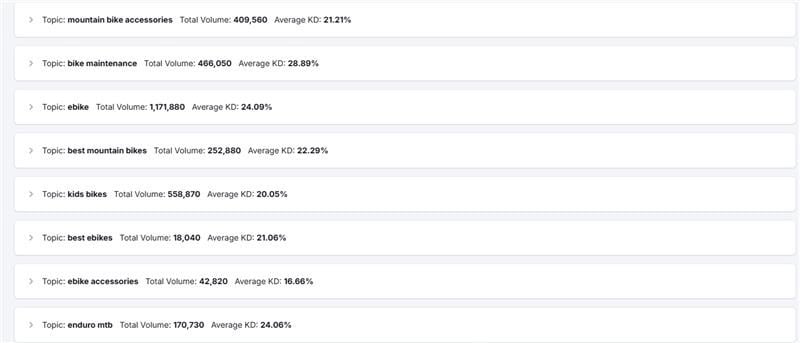
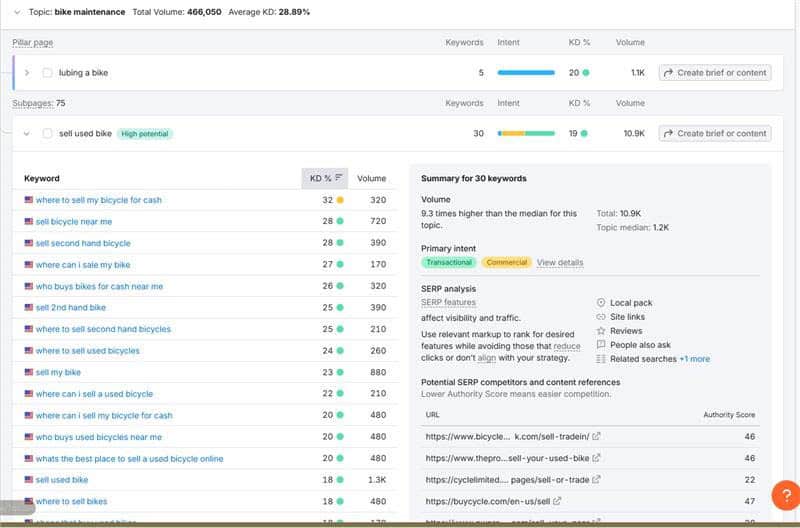
Each Pillar and Subpage already includes a breakdown of the keywords you can use, the search volume, and the difficulty.
SEO Tips for Startups: Beyond the Basics
Now that we’ve gone over the basics, it’s time to start going over intermediate to advanced SEO tactics. This will include technical SEO, schema markups, internal linking strategies, and site infrastructure.
Rendering & Indexation Strategy
If you haven’t built a website yet or have a site that takes a long time for Google to index, consider having a rendering and indexation strategy. Many startups use React, VUE, or Next.js to build sites because they are easier and faster.
However, Google crawlers don’t always render JavaScript correctly. The best solution is to run server-side rendering (SSR) or static site generation (SSG). That’s why it’s essential to work with web developers who are good with UI/UX and understand technical SEO.
Entity SEO & Brand Signals
Keywords tell Google what you want to rank for, but entities tell Google who you are. Startups often skip this step, but entity SEO is one of the fastest ways to build trust with search engines. At its core, it’s about creating a consistent identity across the web.
That starts from your website and extends to your LinkedIn, Crunchbase, Product Hunt, press mentions, and Google Business Profile. When Google sees that consistency, it starts connecting the dots and treating your brand as an established entity, which also helps with LLM SEO.
Schema markup helps a lot with this. Adding Organization, Product, FAQ, and Review schema gives search engines structured data about your company and its offerings. You can ask for templates from ChatGPT, which’ll give you a Schema to edit and add to your HTML headers.
How to Make Better Use of AI for Content Marketing
SEO strategies that don’t involve blog posting at some point are almost non-existent. And if you don’t have a dedicated content writer who can scale efforts, competitors will leave you in the dust. The solution here is to either outsource content marketing or use AI.
Google doesn’t have an issue with AI content, but it does have a problem with sloppy, spammy AI content. If you want to use AI effectively, give it as much context as possible about your business, your target audience, and how your branding works.
Instead of a one-shot prompt like “write a 1,000-word article about XYZ,” ask it to research the topic first and gather sentiment from online forums like Reddit and Quora. Then, tell the AI to create a content brief based on the research material.
Finally, prompt the AI to write content based on the brief it had just made. Work with the AI as well, per section. That way, you can isolate or correct any issues and edit drafts on the go. And if you have your own ideas about the topic, just word vomit and let AI help you solidify an idea.
Link Velocity and Backlink Building
Your competitors are constantly updating and adding to their backlink profile. But with tools like Ahrefs, you can reverse-engineer where they get their backlinks. Then, it’s all about reaching out to the right people in your industry and niche.
One of the fastest strategies for scaling link velocity is to audit your competitors’ links, get a prospect list of websites to contact, and then run automated email campaigns to reach out in bulk. When you do reach out, here are some of the angles you can try:
- Guest posting
- Niche edits
- Broken links
- Unlinked mentions
- Digital PR
SEO is a Winning Investment for Startups
Startups investing in SEO are seeking long-term, sustainable organic growth. You can start with the basics: internal linking, content structure, and metric tracking.
But startups need advanced SEO strategies like link building, rendering, indexation, and content velocity to scale quickly and move the needle. Spacebar Collective can help you implement these strategies at scale while aligning every effort to your goals. Get in touch with us today!