

AI makes producing SEO content simple, but Jev works differently. Built by TypeSafe AI, Jev is a decision model that evaluates information and makes structured decisions instead of just generating content like common generative models.
Its speed, low costs, and ability to handle large datasets make it appealing for automating repetitive SEO tasks. But speed alone doesn’t guarantee better outcomes.
In this guide, we’ll cover seven practical ways to use Jev for SEO, its limitations, and what to consider before adding it to your marketing tech stack.
What Is Jev and How Does It Work?
Jev analyzes the data you provide and answers your specific questions. You choose the format: multiple-choice selections, numerical scores, or probability estimates.
For SEO, Jev makes it easy to handle large datasets. You can use it to streamline keyword classification, content analysis, and internal linking recommendations.
Understanding Jev’s System One Model
Unlike generative AI tools that create articles or AI content briefs, Jev’s System One model specializes in making fast, structured decisions. It supports three types of questions:
- Choice: Selects from predetermined options, such as classifying keywords by search intent.
- Score: Evaluates information against a defined rubric, such as rating content quality.
- Noul: Returns the probability that a yes/no statement is true, such as whether a page satisfies search intent.
Choice and Score show confidence values, while Noul returns a probability, giving marketers a clear signal for when human review is needed. Jev can also evaluate multiple questions at once, and its low input-token pricing makes it a cost-effective option for large-scale SEO analysis.
How Is Jev Different From ChatGPT or Claude?
Unlike ChatGPT and Claude, which are built for generating content and researching complex topics, Jev is designed to do something different: make fast, structured decisions about data.
Rather than replacing AI copywriting tools, Jev can complement them. For example, ChatGPT or Claude can draft an SEO article. Jev then checks its quality, relevance, and search intent against your criteria.
The final step is the human layer: an SEO specialist reviews the results, makes necessary improvements, and determines whether the content is ready to be published and then distributed.
7 Practical Ways to Use Jev for SEO
SEO involves thousands of small, repetitive decisions. From choosing focus keywords and evaluating search intent to assessing content quality and analyzing competitors, the work adds up quickly.
Jev helps SEO professionals work smarter. Breaking complex evaluations into clear, well-defined questions makes analyzing large datasets faster and reduces time spent on manual reviews.
1. Classifying Keywords by Search Intent
Manually sorting thousands of keywords is time-consuming. Jev makes it simple. It classifies keywords by search intent and maps them to the right stage of your sales funnel, so you can focus on what matters most.
For instance, take 5,000 keywords from Ahrefs or Google Search Console (GSC)and run them through Jev to spot high-intent searches. This way, you can zero in on the keywords most likely to bring in qualified leads and customers, not just traffic.
Keep in mind that Jev only evaluates the data you provide. It doesn’t independently retrieve search volumes, analyze live search results, or discover new keyword opportunities.
2. Identifying Keyword Clusters and Cannibalization
Jev can help you spot keyword cannibalization.
Share your target keywords, titles, headings, and content summaries, and it will check whether your pages compete for the same search intent. It scores their topical overlap and shows you where to consolidate or differentiate your content.
For example, two blog posts targeting “ISP proxies” and “proxy tools” might compete for similar queries. Jev helps you decide whether two keywords belong in the same cluster or need separate pages, based on what each one is meant to do.
From there, you can use GSC to check for overlapping rankings and decide whether to consolidate or expand content. Keep in mind that semantic overlap doesn’t always indicate cannibalization, so avoid creating redirects or deleting pages based solely on Jev’s classifications.
Always have a human review first before taking action.
3. Automating Internal Linking Recommendations
Finding internal linking opportunities takes time, especially when your site has hundreds or thousands of pages.
Jev makes internal linking simple. It scans page titles, headings, and surrounding content to find the most relevant URLs from your predefined list, so you can link smarter, faster.
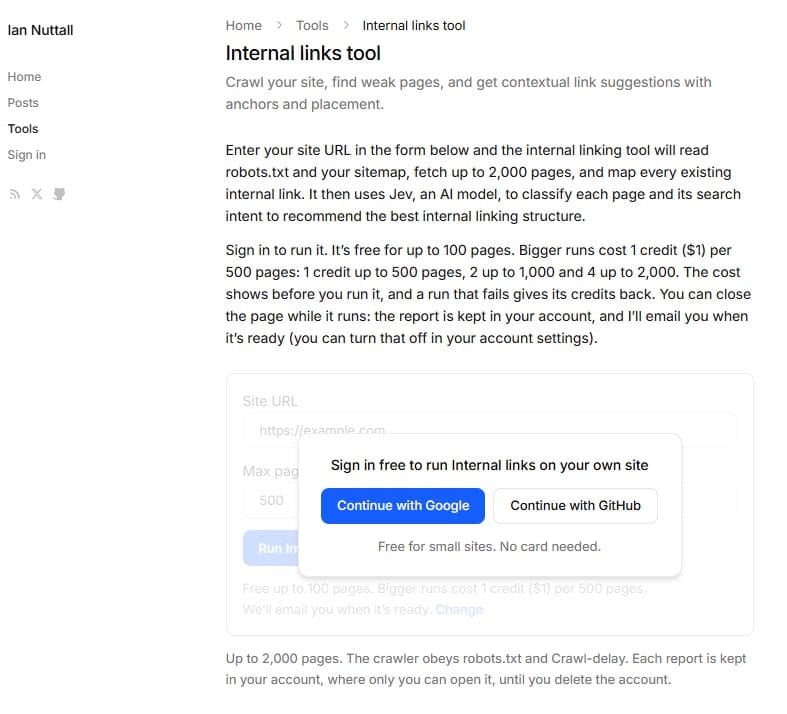
For example, SEO specialist Ian Nuttall built a free internal linking tool powered by Jev. It crawls websites, identifies contextual linking opportunities, and exports recommendations as CSV or JSON files for implementing the links.
Jev handles the relevance evaluations, but separate tools are still needed to crawl pages, identify potential destinations, and implement approved links in your CMS.
4. Finding Content Pruning and Refresh Opportunities
Reviewing hundreds of outdated or underperforming blog posts is time-consuming. Jev simplifies the process by checking content against predefined quality standards and flagging potential issues, including:
- Search Intent Mismatch: Content doesn’t satisfy what users are searching for.
- Thin or Generic Content: Articles lack depth or useful information.
- Content Gaps: Important questions remain unanswered.
- Topical Overlap: Multiple articles covering similar subjects.
Combining Jev’s assessments with GSC data makes it easy to spot pages with dropping traffic, weak rankings, or missed opportunities, so you know exactly where to focus your efforts.
5. Evaluating SEO Content Quality Before Publishing
Jev works as a quality-control layer for both human-written and AI-assisted content, helping editors catch issues before publishing.
With a predefined scoring rubric, SEO teams can easily evaluate articles based on criteria like:
- Search Intent: Does the content satisfy the reader’s search intent?
- Completeness: Are important questions and subtopics covered?
- Usefulness: Does the article provide actionable information?
- Editorial Guidelines: Does the content meet the brand’s writing standards?
Jev can flag drafts that need extra editing. But it can’t reliably tell whether content is AI-generated from writing style alone.
Just remember that a high content quality score doesn’t guarantee better Google rankings. If ranking were that simple or predictable, we’d all be gazillionaires.
6. Monitoring Brand Visibility in AI Search Results
Jev can support LLM SEO by analyzing how frequently brands appear in AI-generated search responses.
Jev reviews saved responses from ChatGPT, Perplexity, and other AI platforms. It shows you whether your brand is mentioned, recommended, cited as a source, or missing entirely.
This distinction matters. A 2026 Semrush study found that 61.7% of recorded brand appearances were citations without corresponding brand mentions.
Jev makes it easy to compare results across competitors, search queries, and AI platforms to spot visibility gaps.
Keep in mind that Jev doesn’t collect AI search responses directly. You’ll need an external monitoring tool to gather the data first, and then Jev can take it from there.
7. Analyzing Competitor Content at Scale
Manually analyzing competitor content is time-consuming, particularly when reviewing dozens of pages. Jev simplifies this by scoring content against a consistent rubric, saving you hours of work.
- Topical Coverage: How thoroughly does the page address the subject?
- Clarity: Is the information easy to understand?
- Supporting Evidence: Does the content include credible sources, examples, or original data?
- Search Intent: Does the content satisfy what users are searching for?
For instance, Jev can analyze top-ranking pages for “social media scheduling software” to identify content gaps and areas for improvement.
The Limitations of Using Jev for SEO
Like we’ve always recommended, AI should be used as a tool rather than a solution. If you’re relying on Jev to handle all your SEO and AEO decisions, you’re gonna have a bad time.
Jev Can Make Incorrect Decisions
Jev’s structured answers aren’t always accurate. Outputs can be incorrect when dealing with ambiguous queries, incomplete datasets, or unclear scoring criteria, even when confidence is high.
TypeSafe acknowledges these shortcomings in its Jev 1.13 documentation, highlighting several known weaknesses:
- Numerical Precision: Jev struggles with calculations and exact counting.
- Date Comparisons: It can misinterpret dates and chronological relationships.
- Irrelevant Context: Unnecessary information can reduce decision accuracy.
- Option Order: Changing the order of multiple-choice answers can influence results.
Jev Cannot Replace SEO Strategy or Execution
Jev can evaluate data, but it can’t independently crawl websites, conduct original research, write articles, or handle backlink building. Those tasks still require additional tools and human expertise.
More importantly, an effective SEO strategy requires understanding your competition, customer intent, search performance, and business economics.
Jev can spot an underperforming page, but deciding whether to rewrite it, merge content, or build backlinks still takes human judgment.
Faster decisions aren’t necessarily better decisions. Without the right strategic approach, Jev could simply help you make the wrong decisions faster. AI tools can amplify and speed things up, but without the right guidance, you could be building in the wrong direction.
Is Jev Worth Using for SEO?
Jev offers considerable potential for SEO agencies and businesses managing large websites. Its biggest advantage is automating repetitive evaluations, particularly keyword classification, content scoring, and internal linking analysis.
However, the benefits depend on the scale of your SEO operations.
| Website Type | Potential Benefits | Is Jev worth it? |
|---|---|---|
| Small Websites (Under 100 Pages) | Faster keyword and content evaluations | Limited value unless workflows are already automated |
| Medium Websites (100–1,000 Pages) | Content audits, keyword clustering, and internal linking | Worth testing for repetitive tasks |
| Large Websites (1,000+ Pages) | Bulk analysis and automated quality control | Strong potential for time and cost savings |
| SEO Agencies | Scalable evaluations across multiple websites | Particularly useful for standardizing workflows |
Before adopting Jev, consider the total cost of implementation, including data collection, integration, validation, and human review, rather than just API pricing.
Jev should make executing your SEO strategy more efficient, not determine the strategy itself.
Build a Smarter SEO Strategy With Spacebar Collective
AI tools like Jev can make SEO more efficient, but they can’t replace a strategy built around lead and revenue generation.
At Spacebar Collective, our managed SEO services combine content creation, technical optimization, and backlink building to drive measurable business growth.
We focus on results, not on adopting AI tools for their own sake.
Ready to grow your organic traffic and conversions? Contact us today to discuss your SEO goals.