
An exploration of what drives rankings and visibility in a market that doesn’t reward guesswork.
Executive Summary
If you run a roofing, HVAC, plumbing, or electrical company, chances are you’ve noticed a difference in online search. Maybe calls that used to come in steadily for your business now feel harder to come by. Or search rankings you’ve held for years are suddenly slipping.
Meanwhile, your ad spend keeps climbing. Google Ads costs more each year, while the returns are starting to flatline. It’s enough to make general contractors question if SEO still works. The answer is yes, but a few things have changed.
We spent the last few months analyzing search data across the home service and trade industries. We then cross-referenced our findings with input from contractors and digital marketing specialists who track Google’s every move.
What we found wasn’t surprising so much as it was clarifying. The contractors winning in local search right now aren’t doing more for the sake of it. Instead, their strategy accounts for several key SEO trends.
Specifically:
- Google is your new storefront. Most customers will decide to call you (or skip you) without ever clicking through to your website. Google is working harder to keep users on the search page. If your Google Business Profile (GBP) isn’t active, updated, and packed with relevant information, you risk becoming invisible.
- Reviews are about quality and velocity. Having a hundred “great job” reviews from 2022 doesn’t carry the weight it used to. Google (and your customers) are looking for specific details of the services you provided and how often the accolades roll in.
- Homeowners want cost and insurance answers before they call. More homeowners are searching terms like “new roof cost” and “insurance coverage for hail damage” before they look up contractors. If you’re not answering these questions, you’re losing qualified leads to competitors who do.
- Service and location pages beat generic websites. A generic page that claims “best plumber in Phoenix” won’t cut it anymore. Leading sites use high-quality content, real job photos, specific neighborhood mentions, and authentic proof of work to demonstrate they are actual local experts.
- Traffic matters less than qualified clicks. Ranking for high-volume keywords means little if it doesn’t lead to steady bookings. Your business focus needs to shift from “how many people saw us” to “how many people called us.”
This report breaks down the 10 SEO trends defining 2026 for home service companies, along with actionable steps you can apply to your website immediately. Whether you have an agency or you’re handling marketing yourself, these are the moves that will help you stay fully booked this year.
| *If you only do three things this year: Optimize your Google Business Profile. Don’t just claim and abandon it. Add specific services, post photos, respond to reviews, and treat your GBP like your new homepage, because for most customers, it is. Answer cost and insurance questions. Add pricing guides to your site. Explain how insurance claims work for storm damage. These are increasingly important trust factors to address. If you don’t, chances are, your competitors will. Get more reviews, but strategically. Ask your customers to mention exactly what they appreciated most about your service. A review that says “they replaced my HVAC in one day and cleaned up the mess” is worth ten reviews that say “Five stars.” |
Industry Context: Why SEO Is Changing
In the past, Google acted like a librarian. You asked a question, and it pointed you to a book (websites). Today, Google wants to be the book. It wants to give the answer, schedule the appointment, and handle the transaction without users ever leaving the search page.
For home service companies, this shift changes everything about how your business gets found. Let’s take a closer look.
Google’s Walled Garden & The Rise of Zero-Click Search
Run a quick search for almost anything related to home services. Chances are, you’ll get your answer on Google’s ecosystem before ever navigating to any specific website.
In March 2025, clicks to Google-owned properties like YouTube and Maps accounted for 14.3% of all U.S. searches, up from 12.1% the year before. That’s traffic that used to flow to external websites. Now it stays inside Google’s ecosystem.
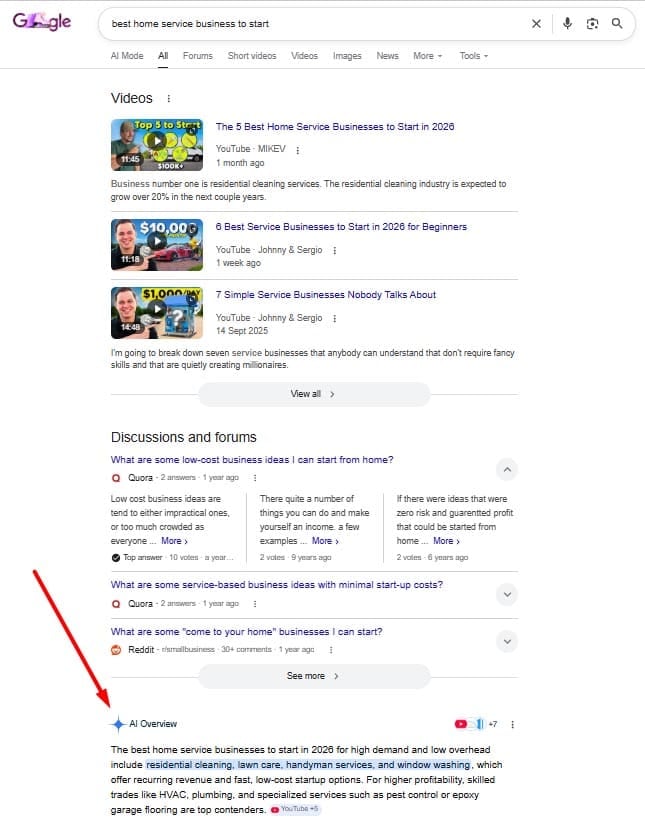
You’ve probably also noticed that an “AI Overview” section appears at the top for quite a lot of searches today.
Source: Google
Depending on the search query, you may also see the local map pack or a Q&A section pulled from sites like Quora and Reddit.
Before readers scroll past all of that to find a traditional website link, they’ve often already found what they need. In the industry, we call this “Zero-Click Search” (getting answers without clicking through to a website).
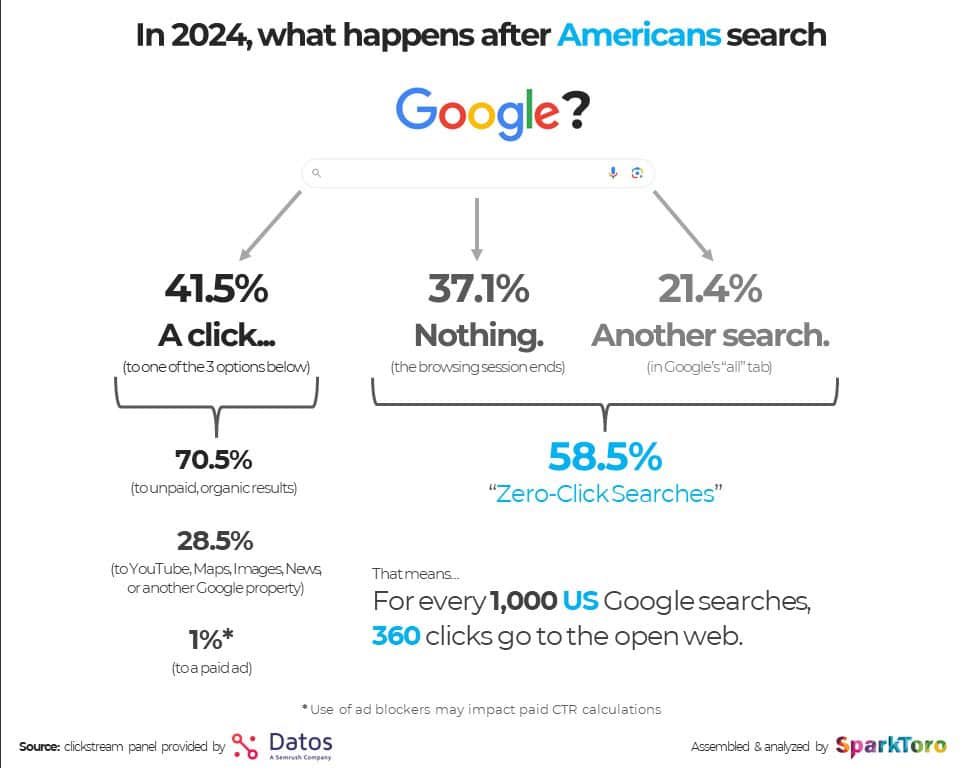
A study from the Institute of Digital Content and Marketing found that 60% of searches now end without a single click to a website. Another study from SparkToro backs this up, showing that 58.5% of zero-click searches are from US audiences.
Source: SparkToro
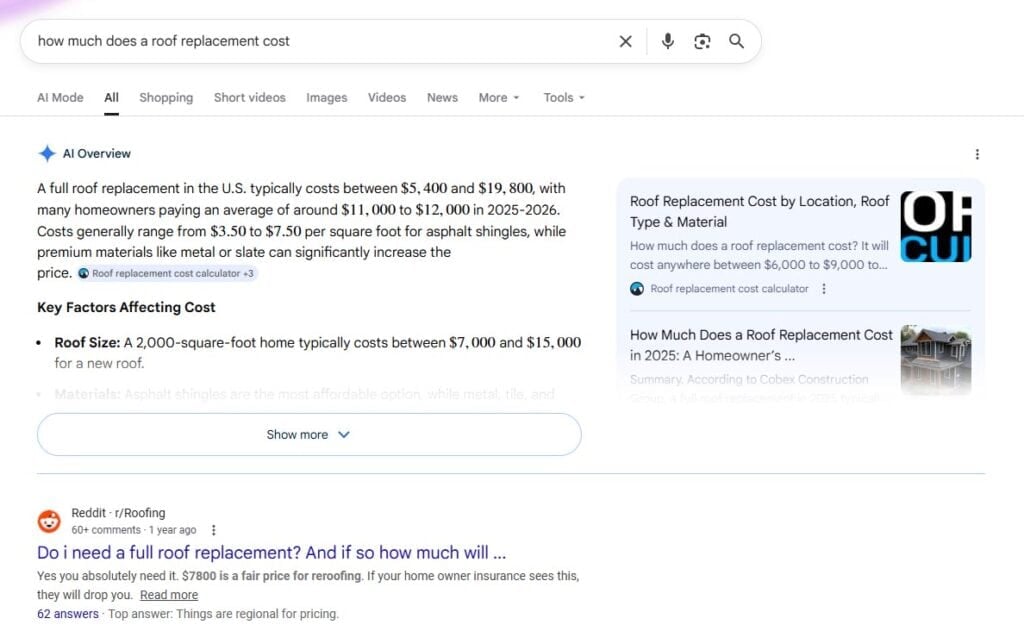
Put simply, more than half of all searches now end without users visiting a website. The search results page itself has become the final destination, not the starting line. So when someone searches, “How much does a roof replacement cost?” Google answers it directly.
Source: Google
For contractors, the trend means you’re getting less website traffic from search than you did, say, five years ago. The good news is that the traffic you do get is more qualified, as long as your website delivers what the search promised.
Relevance, Proximity & Trust Signals Decide Who Shows Up
Relevance has always been the biggest signal Google uses to show a local business in its map pack or expand a Google Business Profile directly in the results.
Proximity (i.e., “near me” searches) has always mattered. But reviews have become a much more important factor. Not just total count, but how recent the reviews are, how often you get new reviews, the specific keywords customers use in them, and whether you respond make an impact on local search results.
A business with 30 detailed reviews from the past six months will typically outperform one with 200 generic reviews collected over five years.
Other important trust signals beyond reviews include:
- Consistent NAP data (name, address, phone number) across directories
- Accurate service descriptions and service-area listings
- Relevant professional photos that are regularly updated
- Response patterns on existing reviews
Google is looking for evidence that a business is active, legitimate, and relevant. And it rewards businesses that clearly provide that evidence.
AI Content Is Flooding the Internet
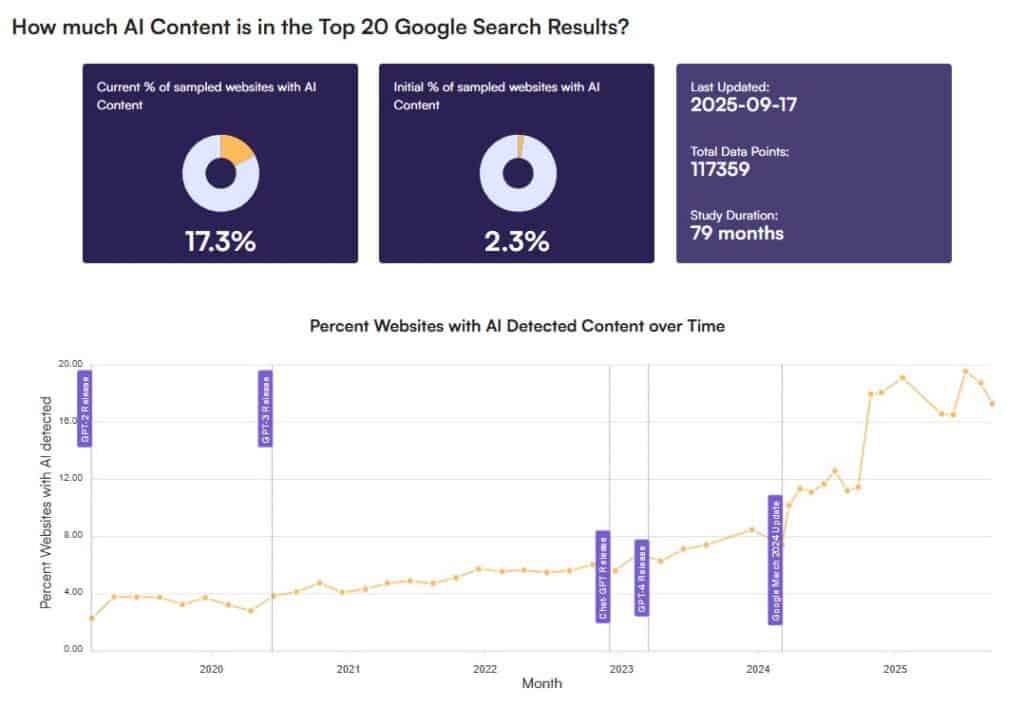
Between 2022 and 2024, AI-generated content went from a rounding error to half the internet. According to a study from Graphite, roughly 5% of new web articles were primarily AI-written before ChatGPT. By November 2024, that figure had surpassed 50%.
The web has never seen an information supply shock quite like this one. And it’s only increasing. Case in point: a study from Originality shows a steady increase in AI-generated content appearing in the top 20 search results.
Source: Originality.ai
For home service companies, the downstream effect is twofold. First, AI has made generic content nearly worthless. If any competitor can publish a “10 Signs You Need a New Roof” article in 30 seconds with no useful insights, that article has no competitive value.
Google knows this, too. The 2025 Search Quality Rater Guidelines now instruct reviewers to assign the lowest quality rating to pages where all or almost all of the content is AI-generated, with little original value added.
Second, Google has raised the value of content that clearly comes from real expertise. First-hand experience, local specificity, real job examples, and honest pricing context are all things an AI can’t generate convincingly, and Google is increasingly rewarding the sites that can.
The contractors who understand these forces are the ones positioning themselves to win in 2026. On that note, let’s go over the important SEO trends for home service companies this year and beyond.
Trend #1: Search Demand Is Strong, But the Keywords Have Shifted
What’s Happening
People are still actively searching for home services such as roofing, HVAC, and plumbing. That hasn’t changed. What has changed is how they’re searching. The broad, brand-awareness-style queries (for example, “roofing company”) have stagnated or declined.
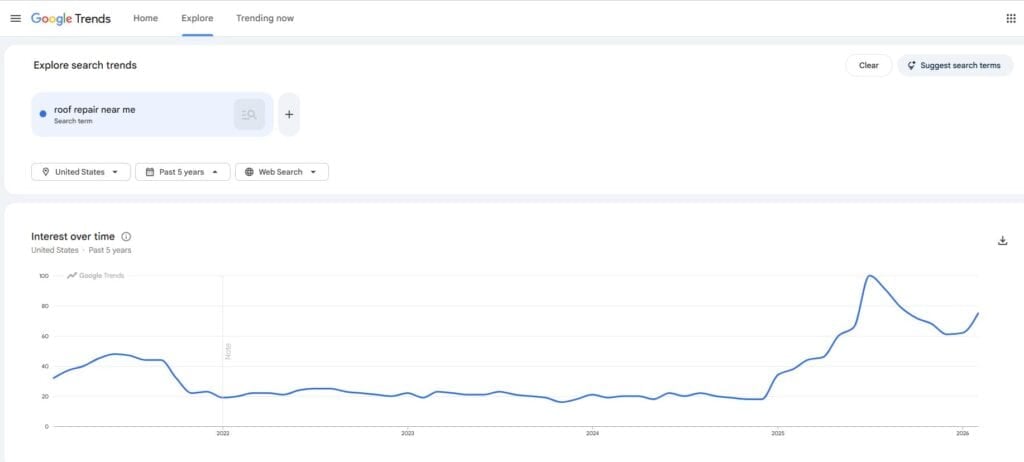
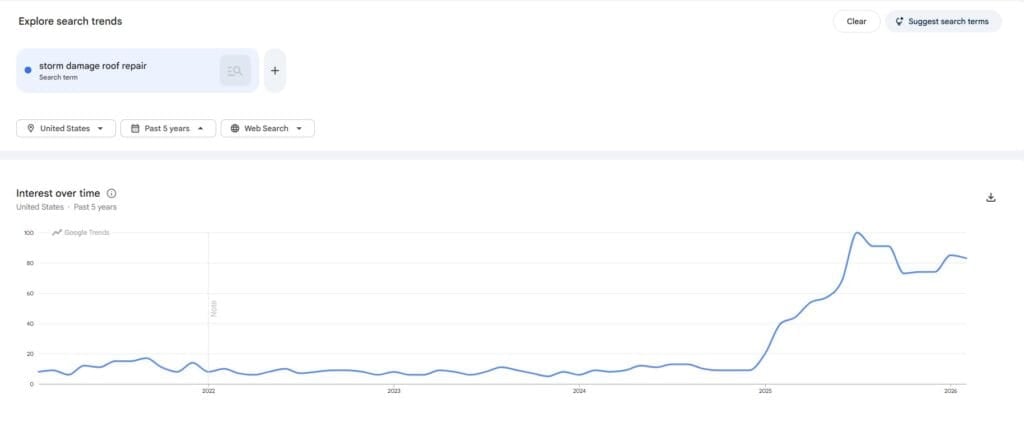
The searches that are growing are specific, intent-heavy, and cost-focused. Searches like “roof replacement cost,” “storm damage roof repair,” and “roof repair near me” are all showing a steady increase in recent years.
Here’s the Google Trends report for “roof repair near me,” for instance:
Source: Google Trends
And for “storm damage roof repair”:
Source: Google Trends
And for “roof replacement cost”:
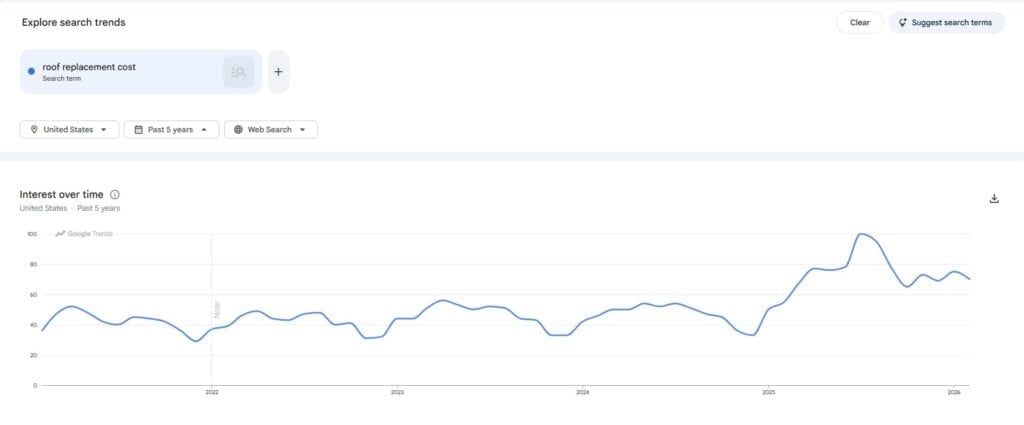
Source: Google Trends
Why It Matters for Home Service Companies
Consider the trend data above, and a pattern becomes clear quickly. Local-intent searches and cost-based searches are outpacing everything else, which means two things.
First, homeowners have gotten more specific. They know what they want, and they’re searching for exactly that. Second, and more importantly, homeowners are doing comparisons and cost research before they contact anyone.
If your website doesn’t have pages built around keywords like “roof replacement cost” or “how much does storm damage repair cost,” you’re invisible at the exact moment a buyer is deciding whether to call you or someone else.
The contractors in those slots aren’t necessarily the best in town. They’re the ones who’ve made it easiest for Google to understand who they are, where they work, and what problems they solve.
What to Do About It
- Audit your current keyword targeting. If your service pages are optimized for “roofing contractor in {{city}}” but not for “roof replacement cost {{city}},” you have a gap worth fixing. The buyer journey now often starts with a cost or problem-based search. Your content needs to be present at that earlier stage.
- Build pages that target growing searches in your market. That means individual service pages, each targeting a distinct combination of service type, intent, and location. Searches like “emergency roof repair in {{city}}” and “metal roof replacement cost {{city}}” show when someone has a specific problem and is ready to act.
- Create storm and damage-specific pages. In roofing and exterior trades, especially, searches spike after weather events. Pages targeting “storm damage roof repair {{city}}” or “hail damage contractor {{city}}” capture that surge.
| Quick Win: Pick your highest-ticket service. Create a detailed “{{service}} cost in {{city}}” page within the next 30 days. Include pricing ranges, 3-5 factors that affect cost, insurance guidance, and customer FAQs. Then link that page directly from your Google Business Profile to win high-intent searches. |
Trend #2: Google Business Profile Is Your New Homepage
What’s Happening
For many of your customers, your website is now a “secondary” source of information. Google has turned Google Business Profile (GBP) into a fully functional storefront where users can see your services, read your latest updates, ask questions, and book appointments.
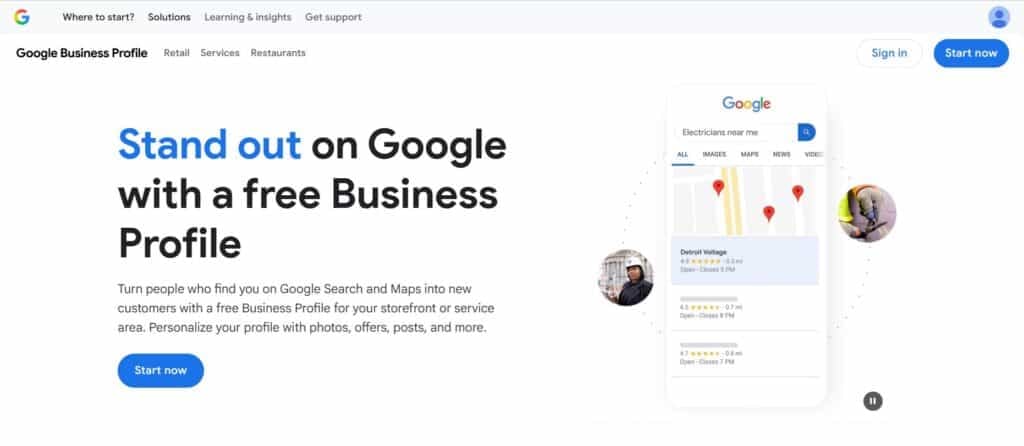
What started as a simple directory listing has grown to include service menus, photo galleries, Q&A sections, booking links, product listings, and regular posts. And the more complete your GBP is, the more likely that Google shows it directly in search results.
For a significant share of home service searches, GBP is now the first (and sometimes only) thing a potential customer ever sees. And according to Google, customers are 2.7 times more likely to trust a business if they encounter a complete Business Profile in search and Google Maps.
Why It Matters for Home Service Companies
A static GBP is a dead end. Google’s local algorithm prioritizes “active” profiles. This means companies that regularly post job site/crew photos, answer customer Q&As, and update their service menus are being pushed to the top of Google Maps.
If your profile looks the same as it did in 2024, Google assumes your business is less relevant than the competitor who posted a “job of the week” photo yesterday.
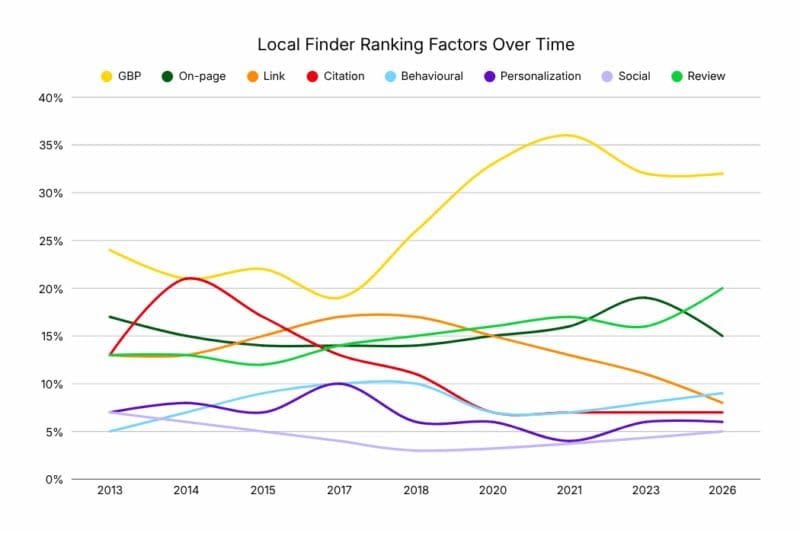
To back this up, a 2026 BrightLocal study found that GBP signals account for as much as 32% of all local pack or map ranking factors. That makes it the single biggest lever most home service companies still aren’t fully pulling.
Source: BrightLocal
| Common Mistake: Choosing the wrong primary category on your GBP is one of the biggest negative ranking factors in local SEO. It’s a mistake that’s more common than it should be, and entirely fixable in a few minutes. |
What to Do About It
- Implement a “location page” strategy. Don’t just point your GBP to your homepage. Create unique service area pages for the different cities you cover. These pages should include local reviews and photos of work done in that specific area.
- Treat GBP posts like social media. Aim for at least two posts per week that are genuinely helpful for homeowners rather than “salesy.” Maybe a photo of a completed HVAC install or a quick tip on how to spot a leaky pipe.
- Answer your own Q&As. Populating your own Q&A section with common financing and lead-time inquiries helps Google understand exactly what you offer.
Trend #3: Reviews = Rankings (and Conversions)
What’s Happening
Reviews stopped being just social proof a while ago. Now they’re a ranking factor with real weight. In the BrightLocal study above, review signals account for 20% of the total Map Pack ranking equation, behind Google Business Profile.
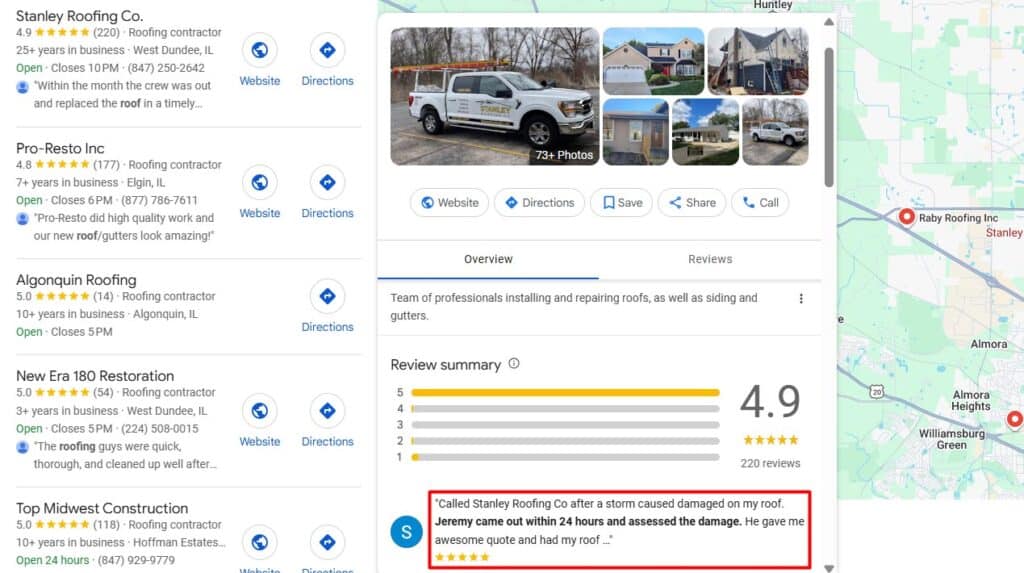
To clarify things a bit further, Google cares less about your total review count and more about review velocity (how fast you are getting new reviews), contextual keywords (what the reviews actually say), and recency (how recent your reviews are).
A business with 500 reviews, but none from the last year, can now lose visibility to a competitor with 200 fresh reviews that mention specific services, like Stanley Roofing Co, below:
Source: Google
The other shift is semantic. When a customer writes, “they fixed my AC the same day and explained the financing options,” Google learns you offer AC repair, same-day service, and financing. That review text now helps match your listing to searches you might not have explicitly optimized for.
Why It Matters for Home Service Companies
Reviews are a primary ranking signal for the Map Pack. Google’s AI now scans your reviews to see if you actually do what you claim to do.
If someone searches for “hail damage repair” and your reviews are full of customers mentioning “hail damage” and “insurance claims,” Google is significantly more likely to put you in the top three for your location.
What to Do About It
- Operationalize your ask: Don’t leave reviews to chance. Train your techs to ask for a review at the kitchen table once the job is done, but before they leave.
- Prompt for keywords: When you send a review link, include a short prompt like: “Could you mention which service we performed (e.g., roof repair or HVAC tune-up)?”
- Respond to everything: Reply to 100% of your reviews. For positive ones, repeat the service: “Glad we could help with your {{service}} in {{city}}!” This reinforces your local authority to Google.
- Use reviews for content: Common questions and praises in your reviews make excellent FAQ content for your website. If three or more customers mention worrying about insurance coverage, you need a page about that.
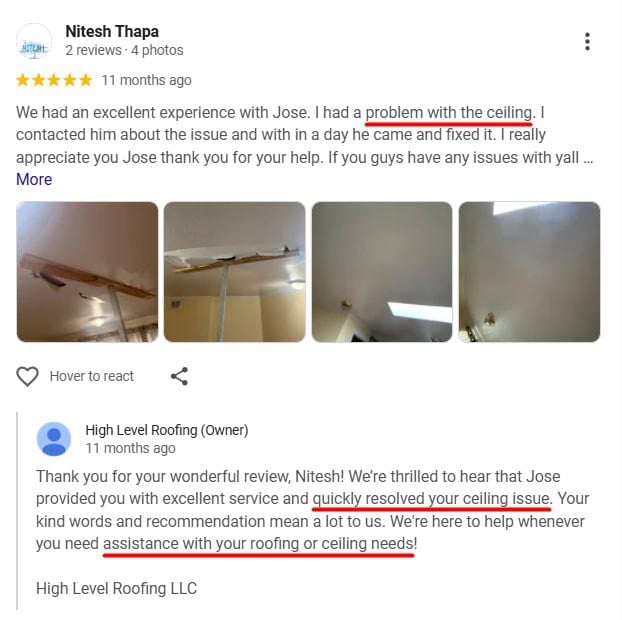
| Quick Win: Take a look at your profile and respond to all unanswered reviews today. It’s a 15-minute task that signals “active business” to the algorithm. For the best results, use the customer’s name and mention the specific service you provided, like High Level Roofing does below: |
Source: Google
Trend #4: The Cost & Insurance Opportunity
What’s Happening
This is arguably the single biggest shift in home service search behavior over the last three years. Homeowners are increasingly searching for pricing and insurance information before they book calls, using queries like:
- “How much does {{service}} cost?”
- “Will homeowners’ insurance cover {{problem}}?”
- “{{Problem}} repair cost estimate”
- “Does insurance cover {{damage type}}”
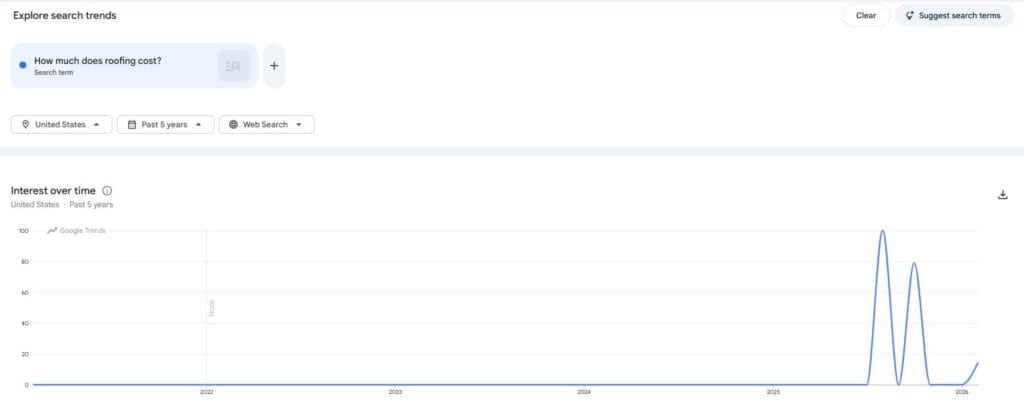
For example, Google Trends search data for “how much does roofing cost” has seen notable spikes between last year and this year. Adjacent search queries reflect the same trend.
Source: Google Trends
Why It Matters for Home Service Companies
Most contractors hesitate to discuss money on their websites because they “don’t want to be held to a price.” While understandable, not addressing pricing means leaving leads on the table.
By being the only one in your market who transparently explains pricing variables and insurance nuances, you capture the customer at the highest point of intent.
What to Do About It
- Create pricing and insurance pages: Break down your “starting at” prices and explain exactly what makes those numbers go up or down (e.g., pitch of the roof, SEER rating of the AC).
- Build pricing and insurance FAQ: Answer the hard questions. “What happens if my claim is denied?” or “How do I read my adjuster’s report?”
- Add a simple calculator: It doesn’t have to be complex. A “roof budget estimator” that asks for square footage and material type is an exceptional lead magnet for high-value replacements.
| Quick Win: Set up a page titled: “{{Your Service}} Cost in {{Your City}}: Real Price Ranges from Local Jobs.” Include three real examples from past projects. That page alone can capture dozens of high-intent searches each month. |
Trend #5: Top Brands Adopt a Cohesive Local SEO Program
What’s Happening
The gap between contractors who are thriving in local search and those who are invisible isn’t as wide as it looks from the outside. It’s mostly a handful of specific decisions made about website structure, content depth, and how the business presents itself online. The good news is that most of these decisions are available to anyone.
Why It Matters for Home Service Companies
The roofing market is competitive, but it’s not evenly contested. Many local businesses still haven’t invested in a cohesive local SEO program. Contractors winning local search results right now aren’t necessarily the biggest operations in their market. They’re the ones who’ve been intentional about how they show up online. Let’s see what separates them:
What to Do About It
- Create deep service-specific pages: Stop lumping everything together. “Roof Repair” should be its own page with its own local project photos, separate from your “Roof Replacement” page.
- Produce location pages that earn their place: The best location pages include local weather context, regional material recommendations, customer reviews in that area, and information on local permit requirements, where relevant. Google can tell the difference between a page written for a place and one that mentions a place.
- Provide transparent pricing information: Contractors who publish honest cost context (ranges, variables, what drives price up or down) consistently rank better for cost-based keywords and convert at higher rates when leads arrive.
- Adopt an aggressive but authentic review strategy: Not just collecting reviews, but doing it systematically by asking every customer, responding to every review, and coaching customers to describe the specific work done.
- Make your “About” and team pages feel human. An About page with a genuine story (how the company started, what they stand for, etc.) drives bookings more than most realize. It matters enormously in a category where scams and no-shows are a legitimate consumer concern.
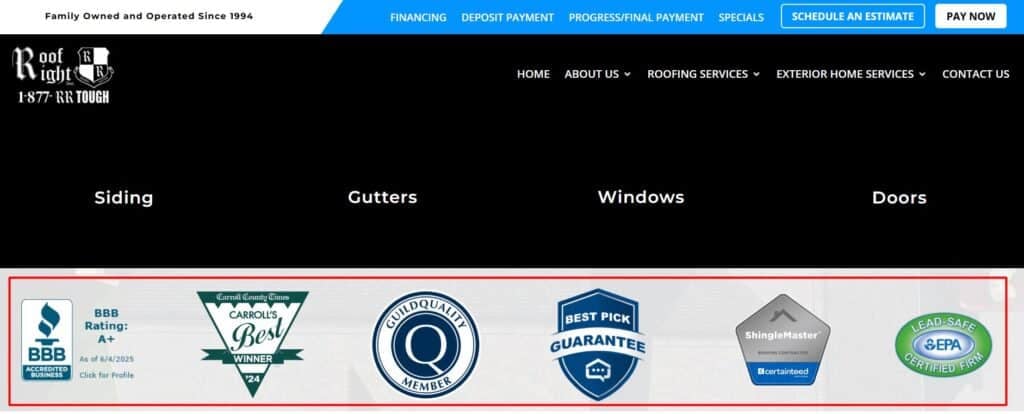
- Provide proof of legitimacy front and center. Certifications, manufacturer designations (GAF Master Elite, CertainTeed SELECT ShingleMaster, etc.), state licensing numbers, insurance details, and BBB accreditation should all be on your homepage and service pages. They answer the trust question before a buyer has to ask it. Here’s an example from Roof Right:
Source: Roof Right
| Quick Win: Delete every stock photo of a “smiling technician” from your website. Replace them with photos of your team, real job sites, or your branded trucks. Even a “non-professional” photo of your actual crew builds more trust than a polished stock image. |
Trend #6: The Rise of the Zero-Click Search
What’s Happening
As mentioned, Google is increasingly answering questions directly on the search page through AI Overviews and other Google-owned properties.
Studies show that organic click-through rates for these queries have dropped by as much as 60% because users get the information they need without visiting a website.
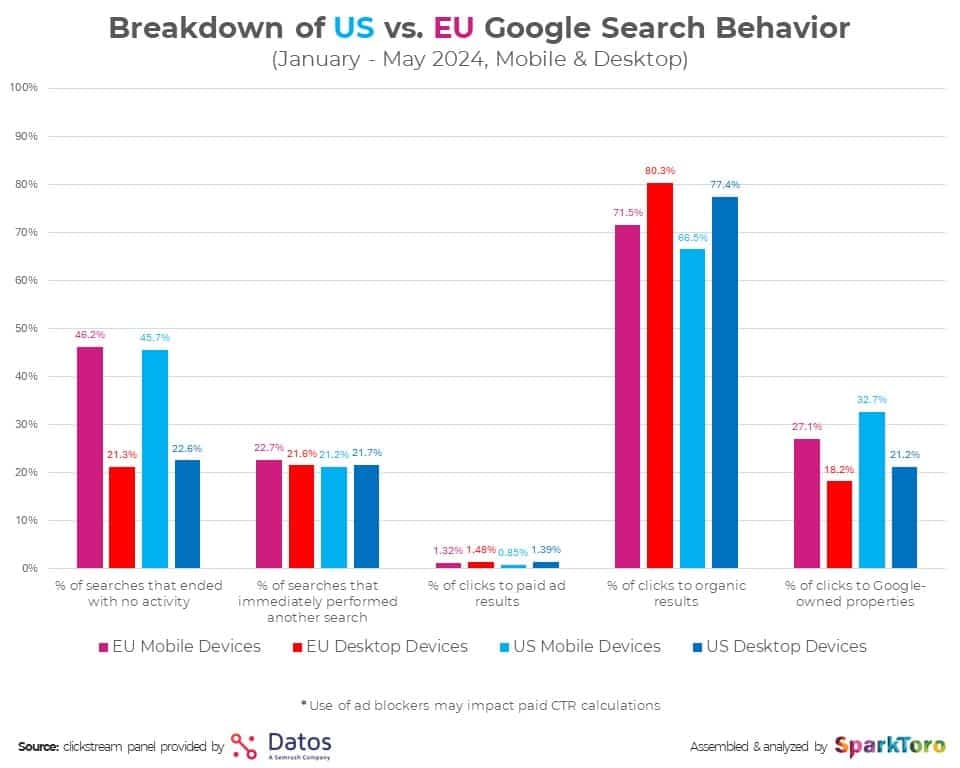
What’s more, US searchers are more likely to find themselves within Google’s ecosystem after a search, compared to other regions like the EU.
Source: SparkToro
That said, high-intent, transactional, local searches like “roofing contractor near me” are far less likely to trigger an AI Overview, and they still drive valuable clicks.
Why It Matters for Home Service Companies
The traffic you’re losing to AI Overview (information queries) was most likely never your best traffic to begin with. So while your total website traffic may decrease, the quality of the visitors who do click through is much higher.
These users have already seen a summary of your expertise and are further along in their decision-making process. Seer Interactive found that brands cited inside AI Overviews earn 35% more organic clicks and 91% more paid clicks than those that aren’t cited.
In other words, if Google’s AI is going to answer the question, the contractors whose content and positioning are authoritative enough to be referenced inside that answer still win.
What to Do About It
- Optimize for citations & conversion Quality: Structure your content with clear headers and bulleted lists so Google’s AI can easily “source” your business. Then build pages that answer the questions buyers ask right before they call (cost, insurance, timelines, materials, etc). That content is what earns AI citations and what converts the clicks that do come through.
- Use precise data. Provide specific statistics and facts about your services that an AI can extract and attribute to your brand.
Trend #7: Local Link Building Is Back (and It’s More Powerful) What’s Happening
Links from other websites to yours have always mattered for SEO. But search algorithms have gotten significantly better at distinguishing locally relevant links from generic ones. A link from your city’s Chamber of Commerce or a local news story carries more weight than a directory listing that any business in any city can get with a credit card.
Why It Matters for Home Service Companies
Most roofing companies either ignore link building entirely or buy cheap directory links that don’t move the needle. Contractors who win in competitive local markets have real-world authority.
They’re embedded in their communities in ways that generate natural, locally relevant links. These signals prove to Google that you are a physical, trusted part of the community you serve.
What to Do About It
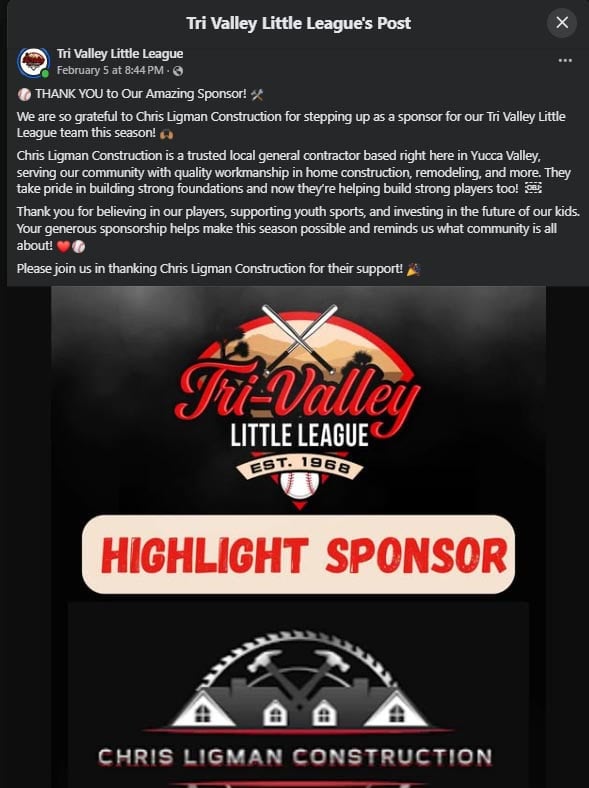
Think about link building the way you’d think about reputation in your community, because that’s essentially what it is online. Sponsor a local charity event or Little League team and get a link from their website (plus great word-of-mouth recommendations).
Source: Tri Valley Little League post
You can also join your Chamber of Commerce and get listed in their directory. Or ask your roofing materials supplier if they have a “local contractor” page.
Or reach out to a local news outlet the next time a major storm hits your area. You’re the expert, and journalists need quotes.
Every one of these activities generates a link that a national competitor can’t replicate because they aren’t local.
| Quick Win: Look up “{{your city}} Chamber of Commerce members directory” and register. It’s typically under $1000 annually, and the link you get is one of the cleanest local authority signals available. |
Trend #8: “Helpful Content” Means Structure & Proof Over Length
What’s Happening
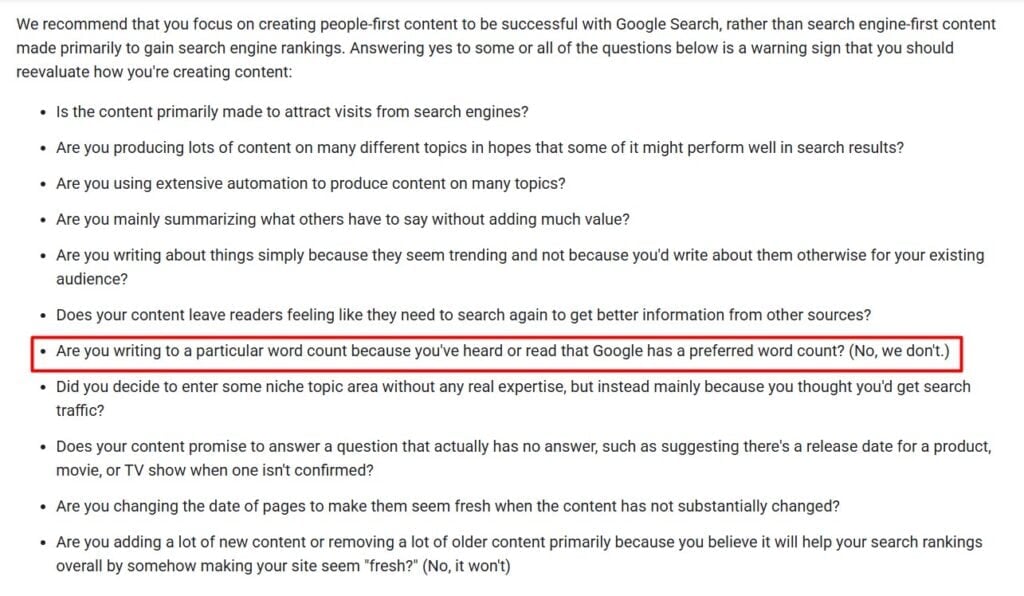
Google’s Helpful Content guidelines have always technically been about quality over quantity. But the industry largely gravitated toward content with a high word count that covered every possible subtopic because it had a better chance of ranking for a wider variety of keywords.
In 2026, however, Google’s algorithm and its helpful content guidelines have clarified, in no uncertain terms, that word counts don’t matter:
Source: Google for Developers
Why It Matters for Home Service Companies
Homeowners don’t want to read a long essay about the history of shingles. They want to see that you have successfully fixed a roof like theirs in a neighborhood like theirs. Pages that lead with photos and FAQs are outperforming text-heavy “SEO blogs.”
What to Do About It
- Post photos from actual jobs
- Build before-and-after galleries
- Provide FAQ pages that answer the questions customers ask
- Share pricing context that reflects real-world numbers
These signals tell Google (and your readers) that this page was built by someone who does this work, not someone who wrote around it.
| Quick Win: Pick your highest-traffic service page and add a before/after photo from a recent job, one paragraph about what that service typically costs in your area, and at least two FAQs based on questions you typically receive from customers. |
Trend #9: Content Gaps Continue to Grow in Roofing SEO
What’s Happening
We analyzed the websites of 25+ roofing companies across major U.S. markets, looking for patterns in what the top-ranking contractors have that others don’t. The gaps were consistent and, in most cases, easily fixable.
Most sites are missing pages that buyers search for, including:
- Roof repair cost
- Roof replacement financing
- Will insurance cover hail damage?
- Emergency tarp services
- Storm-specific repair guides
- City-level service pages
If you analyze 25 competitors in a metro area, you’ll usually find the same problem.
Why It Matters for Home Service Companies
These content gaps are the clearest, most actionable SEO opportunities available to contractors right now. The top-ranking sites have already figured this out. If your website still has one general “Services” page, a contact form, and a few stock photos, you’re not competing as effectively as you could.
What to Do About It
Audit your site against the content gap list above. For each of your core services, you should have a dedicated page with a clear description, pricing context, job photos, and a visible call to action.
For each city or region you serve, you should have a unique location page. And you should have at least one page each on pricing, insurance, and financing, because those are the questions buyers ask before they call anyone. If you only work within one city, you can create pages for individual neighborhoods.
| Quick Win: Google your most important service in your city right now. Click the top three results. Write down every page type and topic they cover that you don’t. That list is your content backlog. Start with whichever missing piece a buyer is most likely to search for. |
Trend #10: CRO Becomes Part of SEO
What’s Happening
Ranking at the top of Google becomes a vanity metric if it doesn’t lead to a steady stream of phone calls. Conversion Rate Optimization (CRO) is now an essential part of a successful SEO strategy.
62% of consumers will avoid a local business if they find incorrect or inconsistent information online. And that’s before we get to the subtler friction points, like:
- Forms that are too long
- Pages that load too slowly
- Phone numbers that aren’t clickable on mobile
- Pages that don’t tell the visitor what to do next
- Quote flows that feel like filing a tax return.
Why It Matters for Home Service Companies
In local services, most conversions happen by phone. That means the job of your website isn’t really to close the sale but to make calling you feel like the obvious, easy next step. Every element that creates friction or uncertainty between “I found this site” and “I’m dialing” is costing you jobs.
What to Do About It
- Your phone number should be in the top-right corner of every page, clickable on mobile, and repeated at the bottom.
- Your primary call-to-action should appear above the fold on every service page and be impossible to miss on mobile.
- Your contact form should ask for the minimum information necessary to follow up: name, phone, and service needed.
- Use call tracking so you know which pages and campaigns are actually generating calls, not just traffic.
If you have multiple service pages, you should know which ones are converting and which ones are just collecting impressions. That data tells you where to focus.
Industry data shows the average professional service site converts at about 6.1%. If you can move that to 8%, you’ve effectively increased your lead volume by nearly 30% without spending a single extra dollar on ads or SEO.
| Quick Win: Pull up your website on your phone. Can you tap your phone number directly to call? Is there a clear CTA visible without scrolling? Does the page load in under three seconds? If the answer to any of those is no, fix it before you spend another dollar on SEO or ads. |
What Winning Home Service SEO Looks Like in 2026
Here’s what the actual setup looks like for a roofing company that’s consistently winning in local search right now.
- A Clean, Logical Website Structure: Winning sites don’t confuse the user or Google. They have clear “Service” pages (e.g., Roof Repair, Roof Replacement, Gutter Installation) and distinct “Location” pages for every major city they serve.
- An Active Google Business Profile: The profile isn’t just claimed but updated at least once a week with project photos, seasonal tips, and answered Q&As. It looks like a living, breathing business.
- A High-Velocity Review Engine: These companies don’t just have “a lot” of reviews. They have a steady stream of new ones. Their reviews often mention specific services and neighborhoods, which helps Google categorize them accurately.
- Local-First Authority: Instead of chasing generic backlinks, winners focus on their own backyard. They have links from the local Chamber of Commerce, youth sports sponsorships, regional news features, etc. This tells Google they are a physical, trusted part of the community.
- Trust Signals Everywhere: Licensing, insurance, BBB badges, and manufacturer certifications are visible in the header or footer of every single page. The message is clear: we are legitimate and insured.
- Real Proof of Work: Stock photos are gone. In their place are high-quality galleries of actual jobs. You see the crew and the finished product. This builds more trust than a thousand words of sales copy.
- A Frictionless Website Experience: The site loads in under three seconds on a 4G connection. There is a “Call Now” button that follows the user as they scroll. Booking a quote takes less than 60 seconds. Everything is made as easy as possible for visitors.
2026 SEO Checklists for Contractors
Google Business Profile Checklist
Website Checklist
Content Checklist
Local Links Checklist
Review Strategy Checklist
Tracking + Reporting Checklist
The 2026 Benchmarks: How Do You Measure Up?
Use these targets as your North Star. If you’re hitting these, you’re going beyond competing to dominate your local radius.
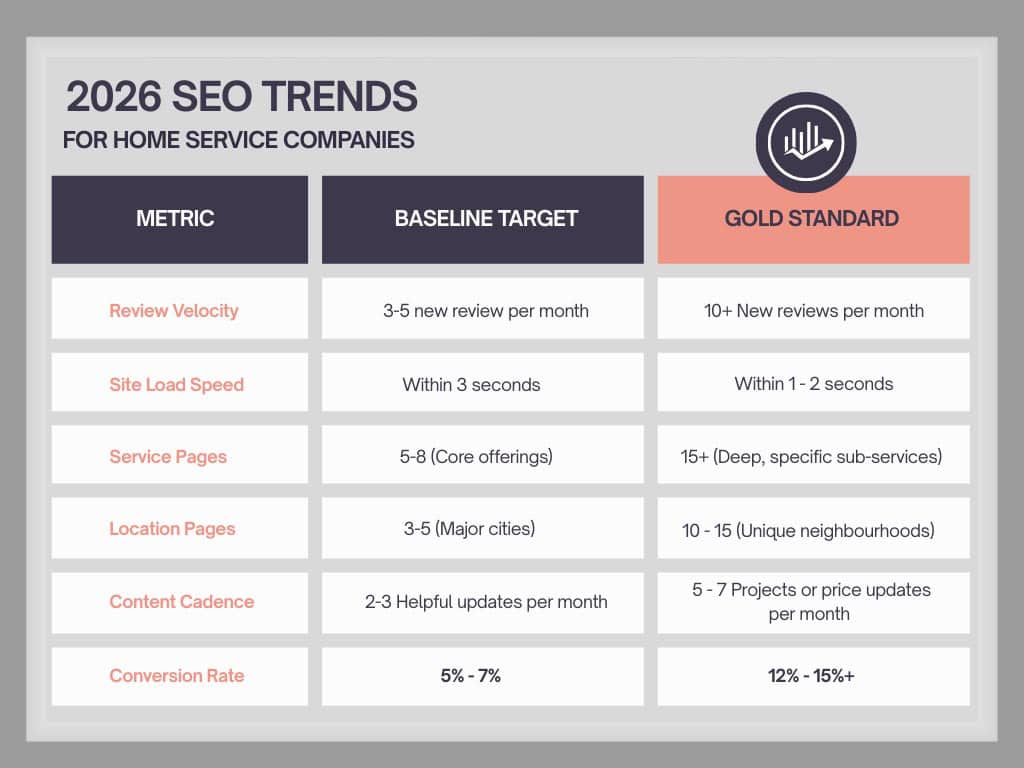
| A Note on Conversation Rates: In 2026, a “good” conversion rate depends on the urgency. For emergency repairs (plumbing/HVAC), elite sites are seeing north of 15%. For high-ticket replacements (roofing), 5% to 8% is a very strong baseline for organic traffic. |
Want a Free Local SEO Snapshot?
This report covered quite a lot. But every market is different. What works in Houston might not hit the same in Minneapolis. Storm damage drives searches in some areas. Cost questions dominate in others.
If you want to know exactly what’s standing between you and the top of the search engine results, we can help. At Spacebar Collective, we offer a comprehensive Local SEO Snapshot that helps contractors and home service companies see exactly where they stand.
What you’ll get:
- The GBP Audit: A breakdown of your Business Profile’s health vs. your top 3 local competitors.
- The Content Gap Analysis: We’ll find the “Cost” and “Insurance” keywords your competitors are currently winning.
- The Speed & Conversion Check: A look under the hood to see if your site is actually built to book jobs.
If you want your Local SEO Snapshot report, email us directly at marketing@spacebarcollective.com.