

Most SaaS teams treat acquisition like it’s the whole game. They pour budget into ads, content, and outbound sequences, measuring success by how many users signed up.
And then those users disappear.
The metric that actually determines whether any of that spend was worth it is activation: the point at which new users genuinely get what the product does. When activation is suffering, the smartest teams turn to dedicated onboarding tools to fix the experience: guided product tours, in-app checklists, step-by-step flows that get users to value faster. Appcues alternatives, such as Hopscotch, were built specifically for this and work well.
But before picking a tool, there are several more fundamental questions to answer: what does activation actually mean for your product, why do so many SaaS companies get it wrong, and what does fixing it do to your revenue? This article covers all of it.
What Is the Activation Metric in SaaS, and Why Does It Matter?
Activation is the percentage of new users who reach a defined value moment inside your product. It goes beyond the signup and the welcome email, all the way to the moment they actually experience what the product is built to do.
Activation is the second stage of the pirate metrics (AARRR) framework, which tracks the customer journey through acquisition, activation, retention, revenue, and referral. While acquisition measures your ability to attract new users, activation determines whether those users find enough value in your product to stick around.
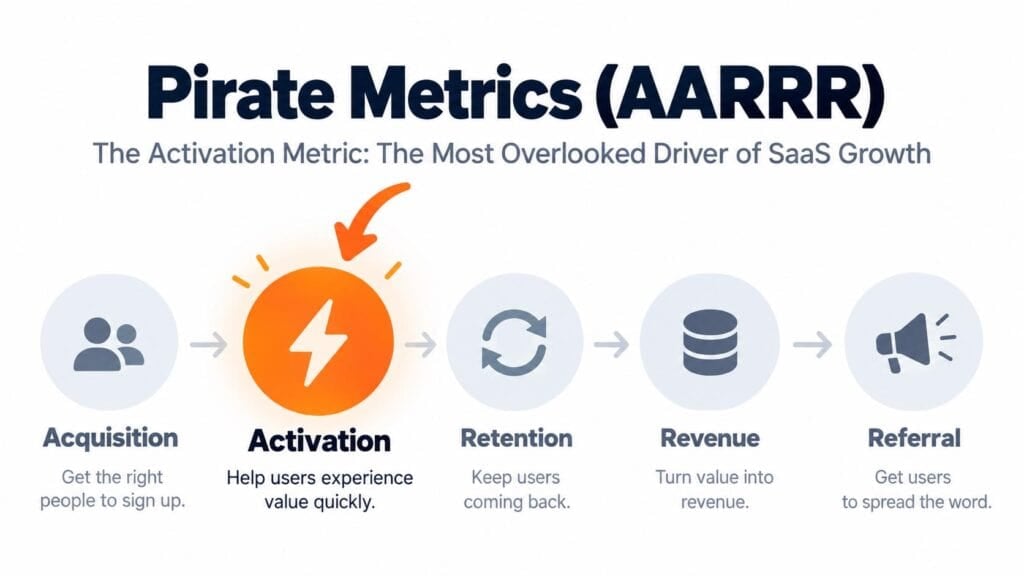
Activation is where acquisition efforts begin to translate into meaningful business outcomes. Users who never experience your product’s value are unlikely to stick around, become paying customers, or recommend it to others. That’s why improving activation can have a ripple effect across every downstream stage of the SaaS growth funnel.
The “aha moment” is a useful frame for this. For Slack, it was a team sending 2,000 messages together—the threshold that Slack CEO Stewart Butterfield identified as the point at which a team had truly put the product to the test. Teams that hit that number showed a 93% retention rate. A confirmed email address tells you someone showed up, but activation tells you they stayed for a reason.
The key metrics to track:
- Activation Rate: The percentage of new users who complete your defined activation event.
- Time to Activation: How long does it take a user to reach that value moment after signup?
- Trial-to-Paid Conversion Rate: The clearest downstream signal of whether activation is working.
The average SaaS activation rate is about 37.5%, according to first-party data from 62 companies. That number leaves a lot of room to work with.
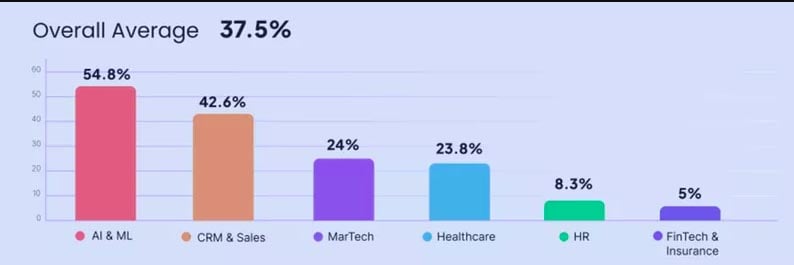
Source: Userpilot
Why Are SaaS Companies Still Getting Activation Wrong?
Activation gets deprioritized because it’s harder to measure than acquisition. Pageviews, signups, and MQL counts are easy to pull. Defining what “activated” means for your specific product requires user research, behavioral analysis, and a willingness to question your assumptions about how people actually use what you built.
Three mistakes that come up repeatedly:
- Treating Signup as Activation: Creating an account is not the same as finding value. When the two get mixed up, your activation numbers look fine on paper, while users are actually dropping off much further down the road.
- Building Onboarding For The Product, Not The User: A tour that walks through every feature in sequence is a product demo. Users care about outcomes, not features, and the flow should connect their goal to the fastest path for achieving it.
- Assuming One Activation Event Fits All Users: In B2B SaaS, a marketing manager and a sales rep using the same platform may have completely different value moments. One definition applied to both will be wrong for at least one of them.
What Does a 25% Increase in Activation Actually Do to Your MRR?
Research confirms that, among all the metrics a SaaS team can optimize, activation yields the highest return. Fairmarkit found that a 25% increase in activation delivers a 34% lift in MRR over 12 months, outperforming the same improvement in acquisition (9.3%) and retention (3.3%). The reason the impact is so outsized is that activation comes before everything else in the funnel. Users who activate are far more likely to:
- Convert from free trial to paid
- Retain past the first 90 days
- Expand into higher-tier plans
- Refer other users organically
Put simply, every dollar spent on acquisition only works as hard as your activation rate lets it.
How Do You Actually Define Your Activation Metric?
Start with your best customers, not your average users. Look at the customers who stayed the longest or expanded their plans and map their behavior in the first 7 to 14 days. Somewhere in there is a specific action that they almost all completed early on, and that action is your activation hypothesis.
From there, test it against 90-day retention and trial-to-paid conversion data. Strong correlation means you’ve found your metric. Weak correlation means digging one level deeper.
Three questions worth working through before you land on a final answer:
- What single action inside the product most closely predicts a user sticking around for three months?
- How long does it currently take a new user to complete that action?
- Where are users dropping off before they get there?
Can a Product Tour Tool Actually Improve Your Activation Rate?
Yes, but only once the strategic work is done. A product tour pointed at the wrong destination is just a well-designed distraction. When it’s pointed at a specific, data-backed activation event, though, it becomes one of the most direct investments a SaaS team can make.
Tools like Hopscotch are built specifically for this: guiding trial users toward their value moment rather than just walking them through a feature list. They do their best work when the activation event is already defined. The right order of operations looks like this:
- Define your activation event based on retention and conversion data before touching any tour builder.
- Map the shortest path from signup to that event, then build guidance around it.
- Identify the drop-off points where users stall, and use in-app prompts to close those specific gaps.
The tour is the delivery mechanism. The strategy has to come first.
Final Thoughts
Most SaaS growth conversations start and end with acquisition, which is why activation stays underfunded for so long. The irony is that improving activation also makes acquisition more valuable: every campaign, every ad, every outbound sequence performs better when the product reliably converts the users it attracts. Teams that get serious about activation tend to find that their acquisition budget was never the problem because the real inefficiency was hiding in the middle of the funnel the whole time.